Why AI-Powered PPC Optimization Beat Traditional PPC Services

12 min read
News



TL;DR
AI marketing optimization delivers 10–20% higher ROI, with seeing 1.4× higher returns and 1.5× faster revenue growth.
Traditional PPC services rely on manual keyword research, slow bid changes, and delayed reports that miss real-time opportunities.
Human errors, time-consuming A/B testing, and reactive optimization quietly drain ad budgets.
AI in PPC provides real-time bidding, smarter targeting, creative testing at scale, predictive analytics, and effortless scalability.
Compared to manual methods, AI offers faster speed, lower error rates, stronger ROI, and actionable insights.
Tools like BidBison automate Amazon Sponsored Ads, cut wasted spend, and free sellers to focus on strategy and brand growth.
Did you know companies using AI marketing optimization tools see 10–20% higher ROI than those sticking with traditional methods? Even better, they report 1.4× higher returns on invested capital and 1.5× higher revenue growth over just three years.
Impressive, right?
So here’s the real question: If AI is driving such big gains, why are so many Amazon sellers still relying on slow, manual PPC management?
The reality is, manual methods simply can’t keep pace with how fast the Amazon platform moves. By the time bids are changed or reports are reviewed, the moment, and often, the sale is gone. This is where AI takes over what manual work can’t.
For Amazon sponsored ad management, that means less wasted spend, smarter targeting, and faster results. Instead of reacting to what happened last week, AI ensures your campaigns stay competitive as they run.
This blog explores why AI-powered PPC outperforms traditional methods and how it can transform your Amazon ad strategy.
Why traditional Amazon PPC management holds you back
Most Amazon sellers start with traditional PPC services, and while they sound helpful, they often create more work than results. Let’s break down why.
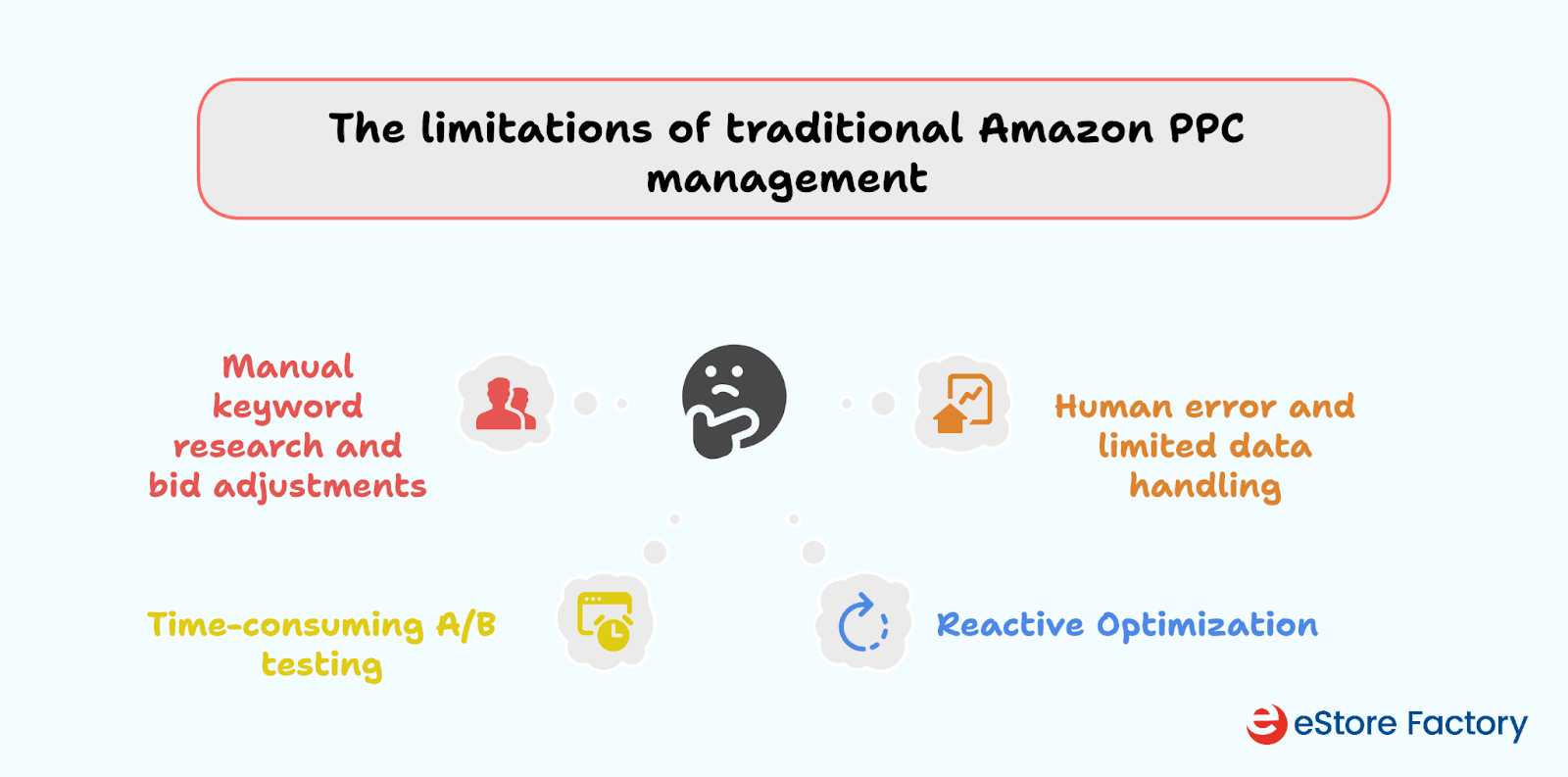
Manual keyword research and bid adjustments: Traditional services usually rely on people running searches, picking keywords, and adjusting bids by hand. The challenge is that Amazon ads move too quickly to keep up with manually. By the time a keyword is updated or a bid is changed, you’ve already lost impressions or spent too much on clicks that don’t convert.
Human error and limited data handling: PPC is all about numbers. But humans can only process so much at once. With so many keywords, ASINs, and campaigns running together, mistakes are inevitable, whether it’s missing a negative keyword or forgetting to lower a bid. Those “small errors” quietly drain your budget.
Time-consuming A/B testing: Testing ad variations is crucial, but doing it manually eats up hours. By the time results are reviewed and changes are made, competitors have already moved ahead with smarter, faster adjustments.
Reactive instead of proactive optimization: Most traditional PPC management reacts to what has already happened, meaning last week’s wasted spend and last month’s high ACoS. Sellers need real-time optimization, not reports of what went wrong after the fact.
That’s where AI-powered PPC tools change the game. Instead of lagging, they optimize as campaigns run, saving time, cutting wasted spend, and giving you an edge over competitors.
How AI-powered PPC is changing your ad strategy
AI isn’t just a buzzword; it’s changing how Amazon advertising works at the core. Instead of humans manually checking numbers and adjusting bids, AI uses machine learning to process massive amounts of data instantly. It spots patterns that sellers could never notice, and it makes complex decisions in real time.
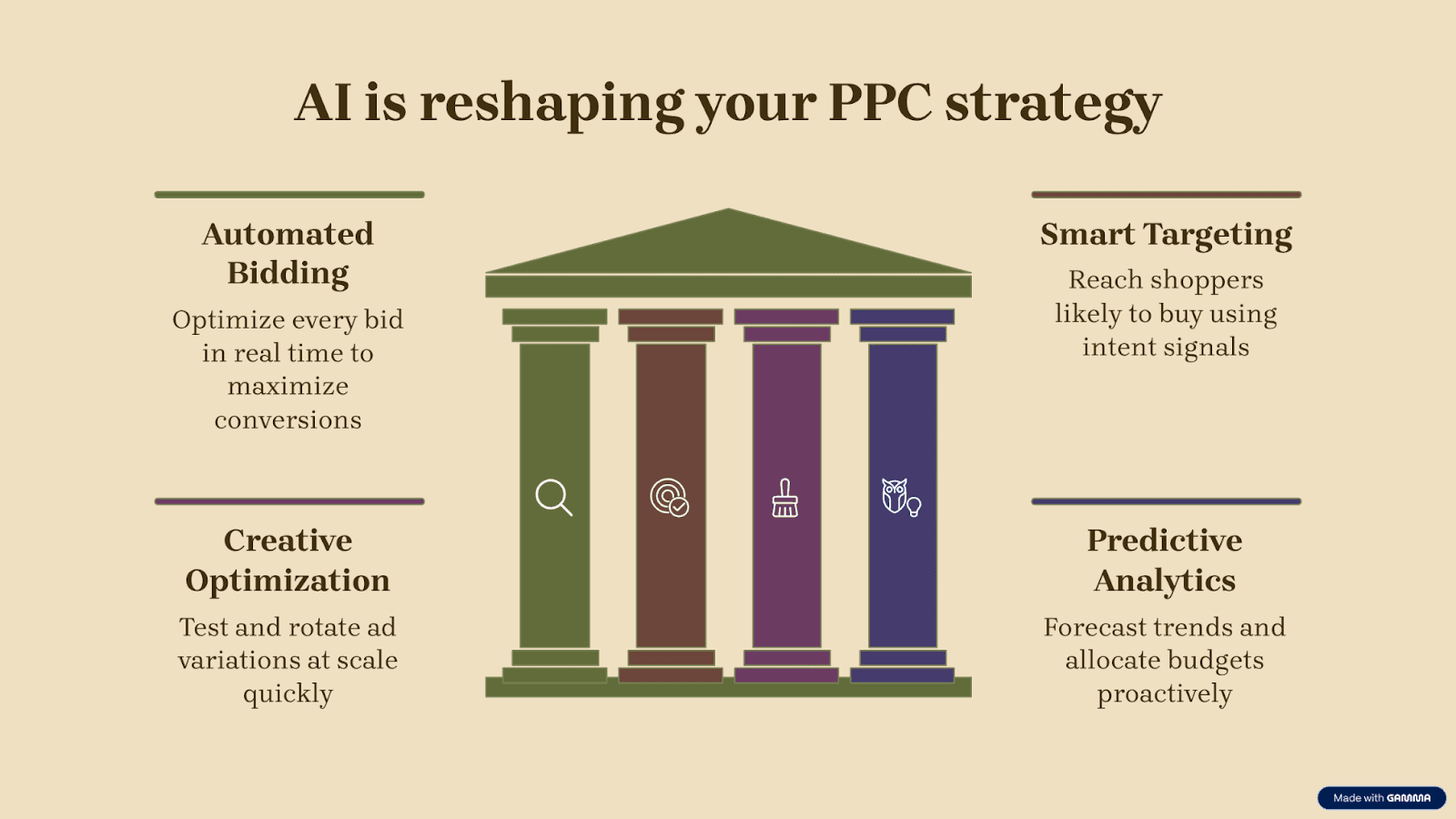
Automated bidding: With AI, bids aren’t adjusted once a week or once a day; they’re optimized every single bid. That means you pay the right price for the right click at the right time, maximizing conversions without wasting spend.
Smart targeting: AI predicts shopper behavior based on browsing patterns, purchase history, and intent signals. Instead of just relying on broad keywords or demographics, it helps you reach people who are actually ready to buy.
Ad creative optimization: Testing ad variations manually takes weeks. AI can create, rotate, and test multiple versions of creatives at scale, finding the highest-performing combinations quickly, without draining your time.
Predictive analytics: AI in PPC management doesn’t just react to past performance. It forecasts what’s likely to happen, helping you allocate budgets smarter and prepare for future trends.
Efficiency and scalability: Repetitive PPC tasks like keyword harvesting, bid adjustments, and reporting are handled automatically. That frees up your time for strategy, while AI handles the execution. Plus, scaling campaigns across multiple products becomes effortless.
In short, AI turns PPC from a guessing game into a growth engine, fast, precise, and built for scale.
AI vs manual PPC management: A simple comparison
Aspect | AI-Powered Optimization | Traditional PPC (Manual) |
Targeting | Predictive, dynamic, and behavior-driven segmentation. | Manual, static audience targeting that often misses buyer intent. |
ROI | Higher efficiency; reduces wasted spend and maximizes returns. | Often less efficient due to missed optimizations and late adjustments. |
Data processing | Analyzes millions of data points instantly, spotting patterns humans miss. | Limited by human capacity; relies on small data samples and periodic reviews. |
Speed | Real-time, instant adjustments during every auction. | Slow; changes only happen after manual checks and reports. |
Testing | Instantly runs multivariate ad tests to find winning creatives and keywords. | Slow, resource-heavy A/B testing that delays results. |
Scalability | Effortlessly scales campaigns across products and marketplaces. | Scaling requires more time, staff, and manual effort. |
Error rate | Automated systems minimize human mistakes. | High risk of human error, missed negatives, wrong bids, or late changes. |
Adaptability | Adjusts instantly to competitor moves, seasonal trends, and CPC shifts. | Lags behind market changes; optimizations are reactive. |
Insights | Provides clear dashboards with actionable recommendations. | Reports are backward-looking and often hard to interpret. |
The future of Amazon PPC
The truth is, Amazon pay-per-click advertising is no longer something you can manage with just spreadsheets and guesswork. Ads move too fast, competition shifts too often, and the data is simply too big. That’s when a smart automation tool takes charge.
AI does the heavy lifting; it can track bids across thousands of keywords, spot wasted spend the moment it happens, and adjust campaigns in real time.
With BidBison, your Amazon Sponsored Ads Automation Tool, those tasks run quietly in the background while you stay focused on growth. No more chasing yesterday’s numbers or stressing over forgotten bid changes.
Now, wondering what your role is in all this? It’s the creative side.
You know your brand story, what resonates with your audience, and how to position your products. BidBison takes care of the optimization while you handle the strategy. Together, it’s a smarter way to scale.
This hybrid approach delivers the best of both worlds: automation that saves time and cuts inefficiencies, plus human insight that keeps campaigns authentic and customer-focused.
BidBison isn’t just another tool; it’s built to give you smarter keyword insights, automated campaign management, and data-driven recommendations you can actually use. The result is simple: more sales, less wasted spend, and more time back in your day.
That’s the future of Amazon PPC, and with BidBison, it’s already here.
Frequently asked questions ( FAQs)
1. Is AI-powered PPC for small Amazon sellers or only big brands?
AI-powered PPC isn’t just for big brands; it works great for small sellers too. In fact, smaller sellers often benefit more because AI helps them stretch every dollar. Instead of wasting budget on the wrong clicks, AI makes smarter bid decisions and finds the keywords that actually convert.
2. How does AI optimize bids faster than manual adjustments?
AI works in real time. Instead of waiting for you to pull reports and change bids manually, it analyzes performance data instantly and adjusts bids. That means your ads stay competitive without overspending. Manual changes might happen once a day or once a week. But AI never stops learning or optimizing, so you get faster, smarter bid decisions that directly improve your ROI.
3. How fast can I see results compared to manual optimisation?
With AI-powered PPC, many sellers see reduced wasted spend and better ACoS within the first few days. Full performance gains usually build over a few weeks as the system learns, but results come noticeably faster than traditional methods. Instead of waiting days or weeks for a manager to review data and make changes, AI adjusts bids and keywords in real time.
4. Is an AI-powered PPC tool too expensive for small businesses?
Not at all. AI-powered PPC tools are often more cost-effective than traditional services because they save you money that would otherwise be wasted on poor targeting or slow adjustments. For small businesses, tools like BidBison are built to give sellers of all sizes affordable access to real-time optimization and better returns. It's actually a smart investment; AI helps you stretch your ad budget further by focusing on what works.
Key takeaways
Manual ad management may have worked in the past, but today’s Amazon marketplace is too competitive and too fast-moving to rely on outdated methods. Sellers need smarter tools that cut wasted spend and deliver results in real time.
That’s exactly what AI brings to the table. By combining automation with human strategy, Amazon PPC management becomes more efficient, predictable, and scalable. BidBison makes it simple, helping you focus on growth while AI keeps your ads ahead of the curve.
Ready to see how BidBison can transform your PPC strategy? Try it today and take the guesswork out of Amazon advertising.

