PPC Mistakes that Kill Profitability and how Automation Fixes Them

10 min read
News



TL;DR
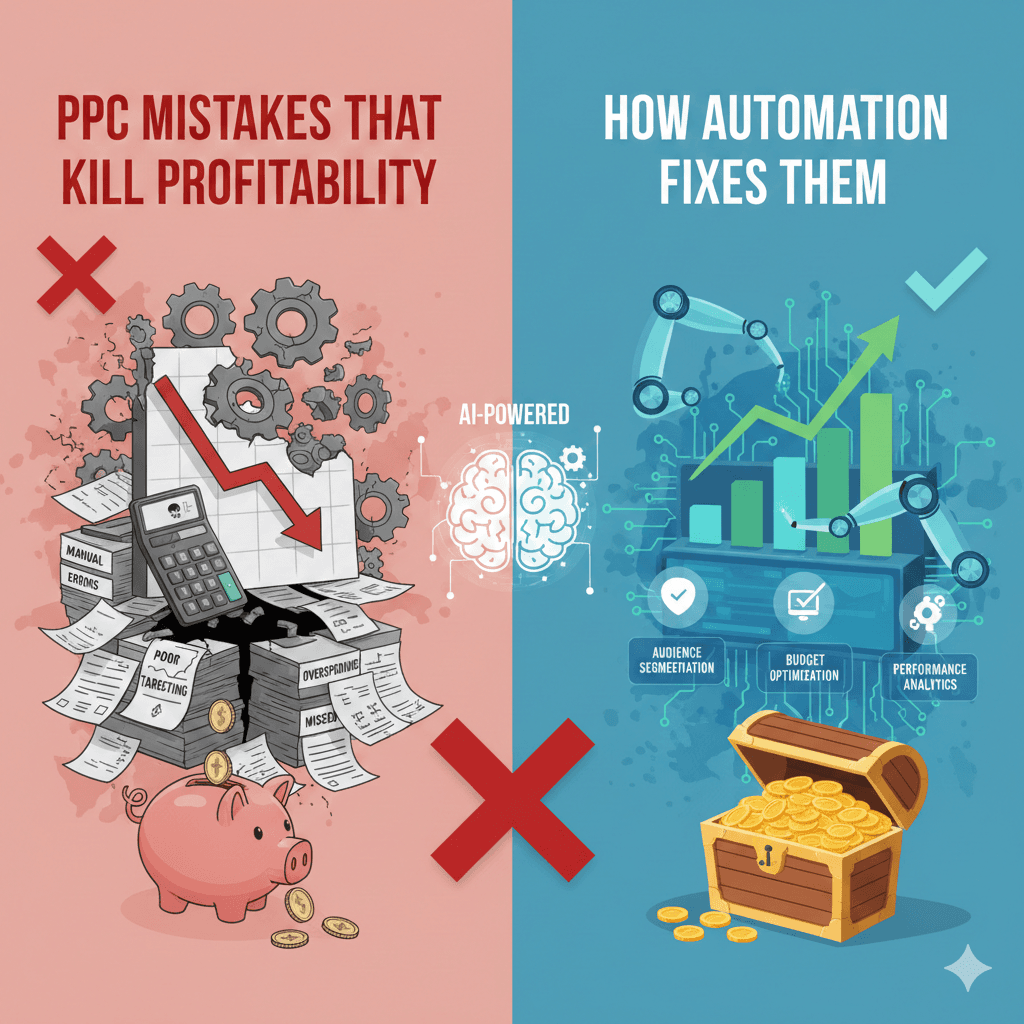
Amazon PPC campaigns often fail due to hidden wasted spend, poor keyword targeting, manual bid adjustments, and a lack of real-time monitoring.
Automation helps by identifying wasted spend early, adjusting bids in real-time, and pausing low-performing search terms.
Targeting the wrong keywords drains budget; automation software continuously optimizes keyword choices based on real shopper data, improving conversions.
Automation tracks search term performance and removes irrelevant traffic, preventing PPC inefficiencies and reducing ACoS.
Overbidding and high CPC are managed with automation, which adjusts bids based on performance, ensuring a more stable cost-per-click and healthier margins.
Scaling campaigns with automation improves profitability by optimizing bidding and budget allocation, reducing the risks of overspending as campaigns grow.
If you feel like Amazon ads are eating more of your budget lately, many sellers are experiencing the same shift. CPC has jumped more than 30% in the past couple of years, and most sellers end up paying the price through rising ACoS and shrinking margins.
The surprising part is that the biggest losses do not come from competition; they come from preventable PPC mistakes happening inside the account. Industry data shows that nearly half of Amazon's ad spend goes to search terms that never convert, which means sellers are losing money long before they even notice it.
But every one of these issues is fixable, and that is where Amazon PPC automation gives sellers a major advantage. Automation reacts faster than any manual workflow, catches wasted spend early, adjusts bids in real time, and keeps campaigns profitable as you scale.
This blog explores the PPC mistakes that quietly kill profitability and how automation turns each one into a growth opportunity.
Why do most Amazon PPC campaigns fail?
Most Amazon PPC campaigns fail for completely fixable reasons.
Hidden wasted spend, not competition
Bad keywords eat budget and hurt ROAS
Manual bid changes are too slow
Manual search term checks miss key trends
Large campaigns are impossible to manage manually
Automation solves this gap and identifies wasted spend early, pauses bad search terms, adjusts bids based on real-time signals, and protects your budget from leaking away unnoticed.
Instead of chasing problems, automation keeps your campaigns in control, improves ROAS, and gives you the freedom to scale without spending hours inside Seller Central. This is why sellers who switch to automation see cleaner data, stronger returns, and faster growth.
Top PPC mistakes and how Amazon PPC automation solves them
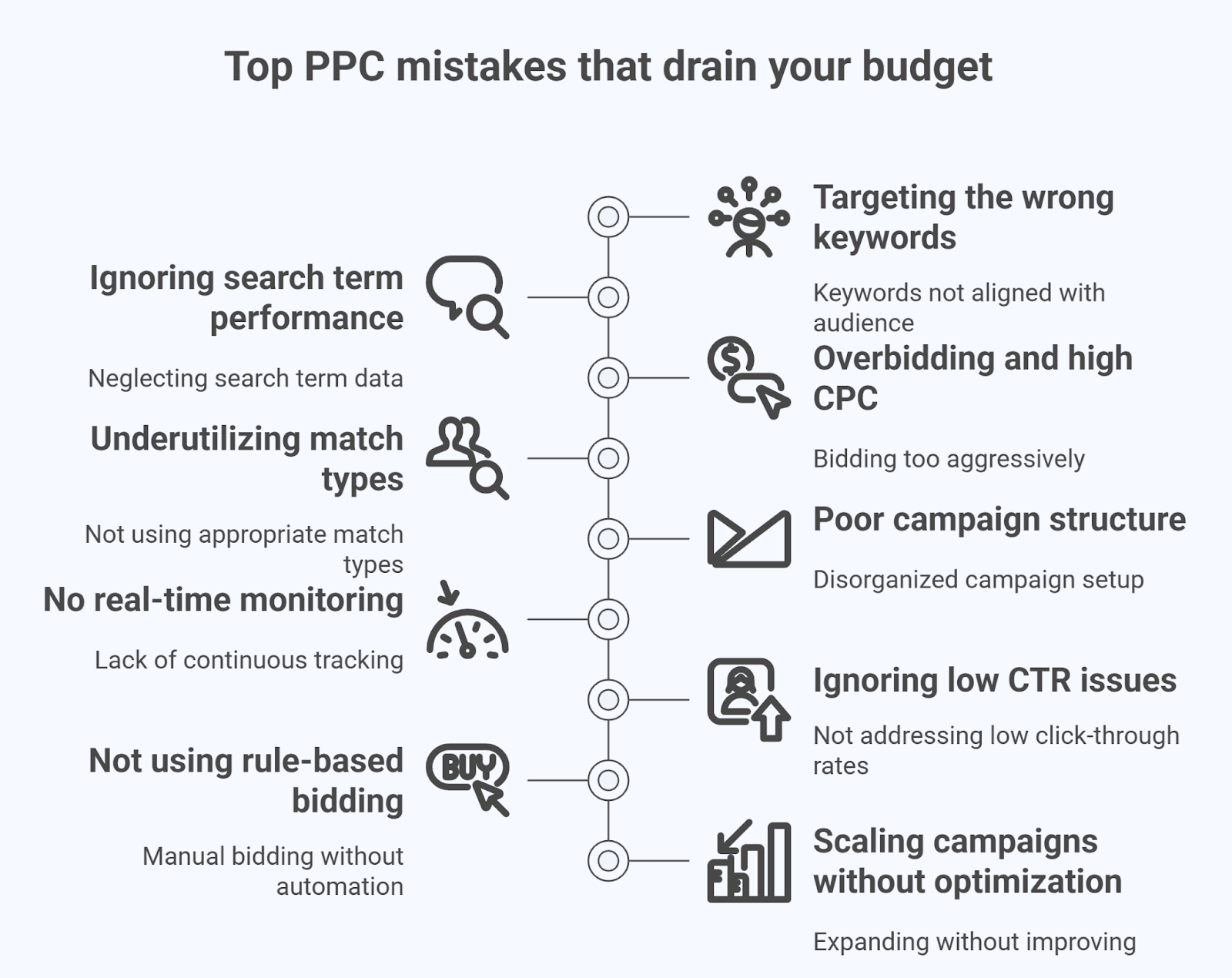
Mistake 1: Targeting the wrong keywords
Targeting the wrong keywords is one of the fastest ways to drain ad spend. Many Amazon sellers rely on guesswork or repeat the same keywords without checking if shoppers are still searching for them. The result is predictable: ads get impressions, costs go up, but conversions stay flat.
This is exactly why so many sellers end up asking, Why are my Amazon ads costing more but converting less?
Automation software solves this problem by taking the guesswork out of keyword decisions. Amazon PPC automation software like BidBison constantly scans real shopper data, identifies high-value terms, and removes the irrelevant ones that quietly burn money.
Instead of manually digging through search term reports every week, the system suggests better keywords, flags wasteful traffic, and keeps your targeting sharp as competition shifts. You get smarter keyword targeting, stronger conversions, and a cleaner ad budget that supports real growth, not accidental spend.
Mistake 2: Ignoring search term performance
Ignoring search term performance is one of the biggest silent revenue leaks in Amazon PPC. Most sellers check search term reports only once in a while because it is time-consuming, messy, and easy to overlook.
The problem is that manual checks miss the hidden patterns that actually drain your profit, like repetitive low-intent queries, runaway broad match traffic, and terms that get clicks every day but never lead to a sale. These unnoticed leaks stack up fast and quietly push your ACoS higher.
Automation closes this gap instantly. Amazon’s ads automatic targeting tool analyzes every search term in real time and highlights what is hurting your campaigns. Bad search terms get flagged, irrelevant ones get removed, and high-intent terms get prioritized automatically.
You also get fresh keyword suggestions based on real shopper behavior, not assumptions. This means your money goes toward search terms that convert, boost visibility, and drive consistent results without constant manual checking.
Mistake 3: Overbidding and high CPC
Overbidding is one of the easiest ways to lose profitability on Amazon. Many sellers increase bids, hoping to get more visibility, only to end up paying higher CPC without gaining meaningful conversions. When your bids are too aggressive, your costs rise faster than your sales, and your margins get squeezed.
If you have ever wondered why your CPC keeps climbing even though your results look the same, overbidding is usually the reason. Automation software for advertising fixes this by adjusting bids based on actual performance, not gut feeling. BidBison uses smart bidding and budget control to monitor every keyword, every hour.
When CPC spikes or a keyword stops converting, the system lowers bids automatically so you do not overspend. When a keyword performs well, it increases bids just enough to capture more profitable traffic, not waste money. This real-time bid adjustment keeps your CPC stable and protects your margins.
Mistake 4: Underutilizing match types
Underutilizing match types is a common mistake that quietly hurts both visibility and profitability. Many Amazon sellers rely only on broad or phrase match because it feels easier, but this often leads to two problems: wasted spend from irrelevant traffic and missed opportunities from not using exact match for high-intent keywords.
Broad match can send your ads into search terms you never intended to target, while phrase match can limit your reach when shoppers use slightly different wording. Without balance, your campaigns stay unstable and unpredictable.
This is where PPC automation software makes a big difference. Automated scripts monitor performance across match types and shift your keyword strategy based on real data. High-performing terms get moved into exact match for stronger control and lower ACoS, while broad match is used carefully to discover new profitable search terms without draining the budget. The result is a balanced match type strategy that helps you scale confidently while maintaining efficiency and protecting your ad spend.
Mistake 5: Poor campaign structure
Poor campaign structure is one of the biggest reasons Amazon PPC breaks down as you scale. When campaigns are messy, keywords are mixed, budgets are spread too thin, and targeting overlaps without control.
The result is wasted spend, unpredictable performance, and no clear sense of what is working. Many sellers only realize this when ACoS spikes or profitable keywords start losing traction, all because the foundation was not organized from the beginning.
The advertising sales management software solves this by building and maintaining healthy structures for you. With tools like BidBison, you can make a winning Amazon ads strategy and manage campaigns effortlessly. The system organizes your keywords into the right campaigns, separates match types, assigns budgets properly, and prevents cannibalization.
As your account grows, the structure stays clean instead of collapsing under complexity. This gives you full clarity, stable performance, and a setup that scales without chaos. A strong structure is not optional; it is the backbone of profitable Amazon PPC.
Mistake 6: No real-time monitoring
Most sellers check their campaigns once a day, sometimes once a week, and that delay creates expensive blind spots. A keyword can burn through your budget, a campaign can hit its limit too early, or CPC can suddenly spike.
The Amazon PPC optimization tool for sellers removes that risk completely. Real-time alerts notify you the moment something goes wrong, so you can fix issues before they snowball. If a keyword starts overspending or performance drops unexpectedly, the system flags it instantly.
On top of that, BidBison helps you track and grow with insights. You get clear analytics and performance reports in one place, so you always know what is working and where to improve. This gives you the confidence to scale your campaigns with accurate data rather than guesswork. Real-time visibility plus actionable insights equals stronger results and healthier margins.
Mistake 7: Ignore low CTR issues
A low click-through rate tells Amazon that shoppers are not finding your ad relevant, which pushes your ads down the page and increases your ACoS. Many sellers think CTR is “just a number,” but it directly affects how often your ads show, how much you pay per click, and how fast you scale.
If your CTR drops, your entire PPC system weakens. Automation helps by identifying the real reasons behind low CTR. Maybe your keywords do not match shopper intent, your ad copy is weak, or your main image is not attracting attention.
Automation-driven solutions analyze these patterns and adjust bids, refine targeting, and boost relevancy automatically. Your ads start appearing for the right shoppers, improving both CTR and conversion rates. When relevancy improves, your CPC drops, your visibility increases, and your campaigns become more profitable with the same budget.
Mistake 8: Not using rule-based bidding
Manual bidding cannot react fast enough when CPC spikes, competitors increase bids, or shopper activity changes throughout the day. You might wake up to see half your daily budget gone before noon, or your best keywords losing visibility during peak buying hours.
Manual adjustments simply cannot keep up with how fast the marketplace moves. This is where automated rules and dayparting make a big difference. Instead of guessing when to increase or decrease bids, rule-based bidding adjusts them automatically based on performance signals. If conversions slow down at night, bids drop.
When traffic is strongest during peak hours, bids rise only for profitable keywords. This ensures every click has purpose and every dollar works harder. With Amazon PPC software with real-time adjustments, your ROAS improves naturally because your bids stay aligned with real shopper behavior.
Mistake 9: Scaling campaigns without optimization
When you increase budgets or bids manually, problems that were small earlier suddenly become huge. Wasted keywords burn more money, CPC climbs faster, and profitable campaigns lose stability. This is why many sellers say their ads were working fine until they tried to scale.
Manual scaling breaks because it amplifies every hidden issue in your account. Automation changes this completely. Instead of blindly pushing more budget, Amazon ads automation optimizes your campaigns in the background while you scale.
BidBison, the best tool to scale Amazon ads profitably, adjusts bids based on real-time performance, removes waste before it multiplies, and reallocates budget to the best-performing keywords and campaigns. As volume grows, the system keeps targeting sharp and costs under control. This gives you predictable growth, not unpredictable ACoS spikes. With automation managing the heavy lifting, you can scale profitably and focus on expanding your brand instead of fighting your PPC.
Final insights
PPC profitability today comes down to speed, accuracy, and the ability to react faster than the marketplace. Sellers relying only on manual management are always a few steps behind, while those who automate early gain a steady, long-term advantage.
Automation removes guesswork, catches problems before they turn expensive, and keeps your campaigns moving in the right direction. If you want to improve efficiency without increasing spend, tools like BidBison from eStore Factory give you the structure and control you need.
This software for Amazon advertising helps you reduce waste, stabilize ACoS, and scale confidently. Start by fixing the biggest leaks, automating the repetitive tasks, and letting data guide every decision.

