Amazon Advertising Guide 2026: Ad Types, Costs and Key Terms Explained
Every Amazon ad type, what it costs, and the five metrics you need to read your campaigns, explained in plain terms.
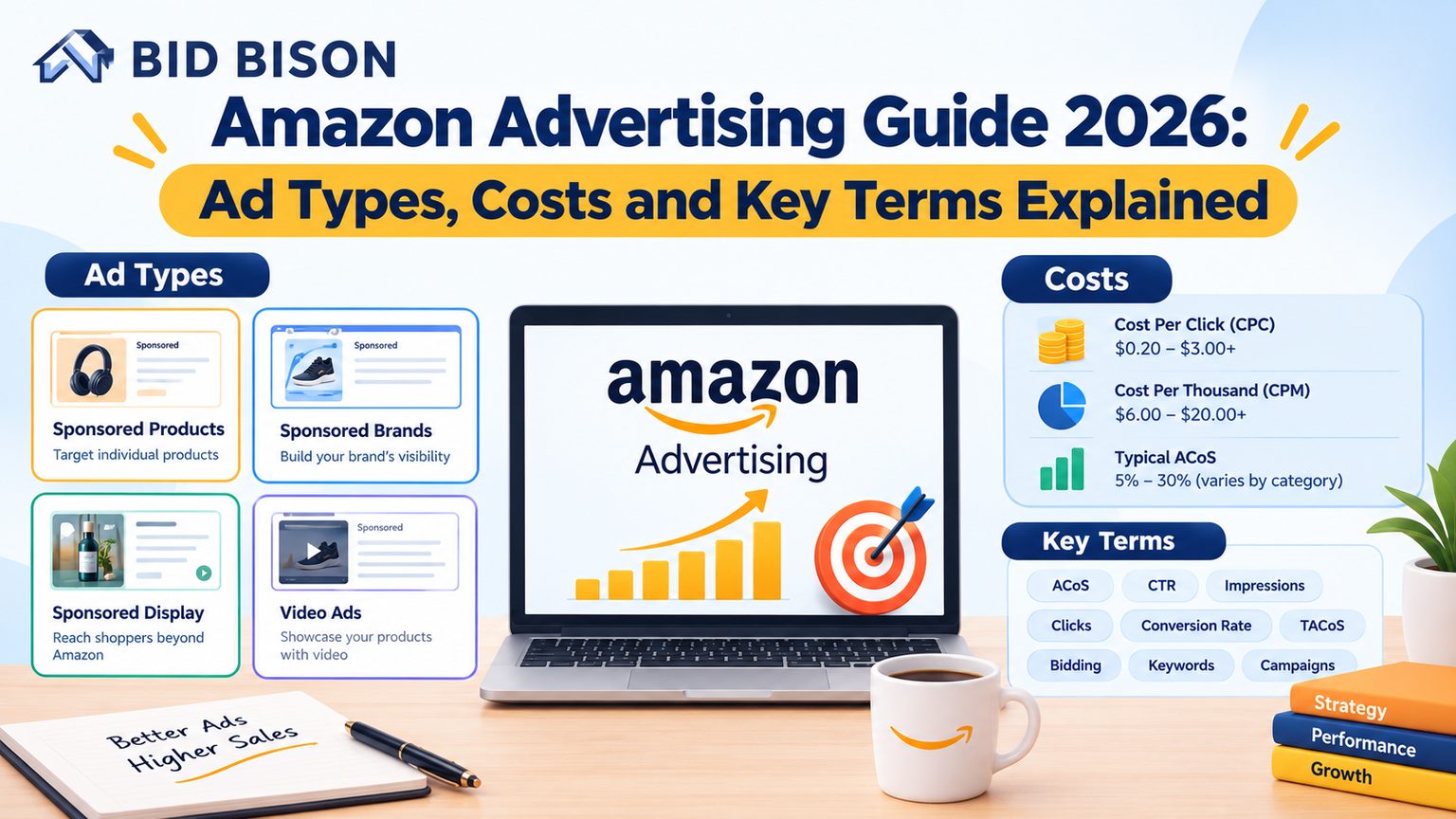
Quick answer: Amazon advertising is a pay-per-click system where sellers bid to show products in Amazon search results and on product pages, paying only when a shopper clicks. This Amazon advertising guide covers the ad types, costs, key metrics and tools, including Amazon PPC software that automates bids around your target ACoS.
Amazon Advertising Guide: What Is Amazon Advertising and How Does It Work?
Amazon advertising lets sellers and brands pay to place products in high-visibility spots on Amazon. You bid on keywords or product targets, and Amazon’s auction decides which ads appear. You are charged when a shopper clicks your ad.
How the Amazon ad auction works
When a shopper searches, Amazon runs an instant auction among eligible ads. It ranks them by bid and relevance. You often pay less than your maximum bid, because the price depends on competing bids.
A higher bid does not guarantee placement. A relevant listing with strong reviews, a good price and healthy conversion earns better placements at lower cost.
Where Amazon ads appear
Ads show in four main places:
- At the top of search results
- Inside search results, between organic listings
- On product detail pages
- On brand pages and, for some formats, off Amazon
Who can advertise on Amazon
Sellers with a Professional selling account in Amazon Seller Central can run most ad types. Vendors use Vendor Central. Some formats, such as Sponsored Brands, require Amazon Brand Registry. You manage campaigns through the Amazon Ads console.
Which Amazon Ad Types Can Sellers Use?
Amazon offers Sponsored Products, Sponsored Brands, Sponsored Display, Amazon DSP, Sponsored TV and Amazon Posts. Sponsored Products drives most sales for most sellers. The other formats build brand awareness and retarget shoppers.
| Ad Type | What It Promotes | Where It Appears | Best For |
|---|---|---|---|
| Sponsored Products | Single product listings | Search results, product pages | Direct sales, new launches |
| Sponsored Brands | Brand logo, headline, 3 products or video | Top of search results | Brand awareness, category defense |
| Sponsored Display | Products or brand, by audience or product targeting | On and off Amazon | Retargeting, competitor conquesting |
| Amazon DSP | Programmatic display, video, audio | Amazon-owned sites and third-party sites | Large budgets, full-funnel campaigns |
| Sponsored TV | Brand video | Streaming TV placements | Brands building upper-funnel reach |
| Amazon Posts | Brand lifestyle content | Brand feed and product pages | Free-to-use social-style reach |
Availability and eligibility rules change, so check the Amazon Ads documentation for your marketplace.
Sponsored Products
These ads promote one listing and look like organic results with a small “Sponsored” label. Most sellers start here because the setup is simple and the purchase intent is high.
Sponsored Brands
These ads put your logo and several products at the top of search results. They suit brands with a registered trademark and a defined catalog.
Sponsored Display
These ads reach shoppers who viewed your product or similar ones. They help recover lost sales and protect your listings from competitor ads.
Amazon DSP
The demand-side platform buys programmatic display and video inventory. It usually needs larger budgets, and many sellers access it through an agency.
How Much Does Amazon Advertising Cost?
Amazon advertising has no fixed price. You set your own budget, and Sponsored Products can start from a very small daily budget. Costs per click vary by category and competition, and are often under $1 in low-competition niches and well above $2 in competitive ones.
Common Amazon cost models
| Cost Model | You Pay When | Used By |
|---|---|---|
| Cost per click (CPC) | A shopper clicks the ad | Sponsored Products, Sponsored Brands, most Sponsored Display |
| Cost per 1,000 impressions (CPM) | The ad is shown 1,000 times | Amazon DSP, some Sponsored Display and TV formats |
What drives your cost per click
- Category competition. Supplements and electronics cost more than niche accessories.
- Keyword type. Broad, high-volume keywords cost more than long-tail keywords.
- Listing quality. Better images, reviews and pricing improve conversion and lower your effective cost.
- Season. Q4 and Prime Day push bids up.
A simple budgeting example
Illustrative example. A seller sells a $30 product with a 35% margin before ads. That is $10.50 profit per unit, so the break-even ACoS is 35%.
If the seller targets a 25% ACoS, each $30 sale can carry $7.50 of ad spend and still leave $3.00 profit.
What Do ACoS, ROAS, CPC, CTR and Impressions Mean?
ACoS is ad spend divided by ad sales. ROAS is ad sales divided by ad spend. CPC is the cost of each click. CTR is the share of impressions that become clicks. Impressions count how often your ad was shown.
Amazon advertising glossary
| Term | Full Name | Formula | What It Tells You |
|---|---|---|---|
| ACoS | Advertising Cost of Sales | (Ad spend ÷ Ad sales) × 100 | How much you spend to earn $1 of ad sales. Lower is more efficient. |
| ROAS | Return on Ad Spend | Ad sales ÷ Ad spend | Revenue earned per $1 spent. It is the inverse of ACoS. |
| CPC | Cost Per Click | Ad spend ÷ Clicks | The average price you pay for each click. |
| CTR | Click-Through Rate | (Clicks ÷ Impressions) × 100 | How often shoppers click after seeing your ad. It signals relevance. |
| Impressions | Impressions | Count of ad views | How often your ad appeared. It measures reach, not results. |
Worked example
A campaign spends $1,000 and earns $4,000 in ad sales. Its ACoS is 25%, and its ROAS is 4.0. If the product’s break-even ACoS is 35%, the campaign is profitable.
What is a good ACoS?
A good ACoS is one below your break-even ACoS. Launch campaigns often run higher to win ranking. Mature campaigns should sit near or below target. Track TACoS (ad spend ÷ total sales) to see how ads affect overall business health.
How Do You Set Up Amazon Ads in Seller Central?
You set up Amazon ads by opening the advertising console from Seller Central, creating a campaign, choosing a targeting type, setting a daily budget and bid, and launching. Start with one automatic and one manual campaign.
- Confirm eligibility. Use a Professional seller account and make sure your listing is active and has the Buy Box.
- Open Campaign Manager. In Seller Central, go to Advertising and select Campaign Manager.
- Create a Sponsored Products campaign. Choose the products to advertise.
- Pick targeting. Use automatic targeting to discover search terms. Use manual targeting for keywords you already know convert.
- Set a daily budget. Start small, then raise it on campaigns that hit target ACoS.
- Set bids. Begin with Amazon’s suggested bid range and adjust with data.
- Add negative keywords. Block irrelevant search terms to stop wasted clicks.
- Review weekly. Check search term reports, move winners to exact match and cut losers.
What Is Amazon PPC Software and How Does It Work?
Amazon PPC software is a tool that connects to your Amazon Ads account and automates campaign management. It adjusts bids, budgets and keywords using your target ACoS and live performance data, then reports results. This replaces manual spreadsheet work.
What Amazon PPC automation software does
Amazon PPC automation software handles repetitive tasks that take hours each week:
- Bid management. It raises bids on keywords that convert and lowers them on keywords that overspend.
- Budget control. It shifts budget toward campaigns that perform.
- Keyword harvesting. It moves converting search terms into manual campaigns and adds negatives for wasteful ones.
- Dayparting. It changes bids by hour or day to match when shoppers buy.
- Reporting. It consolidates performance across campaigns and accounts.
How BidBison fits in
BidBison is an Amazon ads management platform built for this. It automates bids, budgets, keywords, dayparting and reporting around the target ACoS you set. Sellers and agencies can run many campaigns without checking each one by hand.
Software vs. manual management
| Factor | Manual Management | Amazon PPC Automation Software |
|---|---|---|
| Time required | Hours each week | Minutes each week |
| Bid updates | Periodic, by hand | Continuous, rule- and data-driven |
| Scale | Hard past a few dozen campaigns | Built for large catalogs and accounts |
| Consistency | Varies with attention | Follows your target ACoS rules |
| Reporting | Manual exports | Automated dashboards |
Should You Use an Advertising Agency for Amazon?
An advertising agency for Amazon makes sense when you lack time or expertise, or need DSP and full-funnel strategy. Software makes sense when you want control and lower cost. Many agencies use PPC software themselves to serve more clients efficiently.
| Option | Best For | Trade-Off |
|---|---|---|
| In-house with software | Brands that want control and cost efficiency | Needs someone to own strategy |
| Advertising agency for Amazon | Brands that want hands-off management or DSP | Higher fees, less direct control |
| Fully manual | Very small accounts or testing | Time-heavy, hard to scale |
Agencies and PPC professionals can also use a platform like BidBison to standardize reporting and automate routine optimization across client accounts. See how this works on the BidBison website.
Pro Tips and Common Mistakes to Avoid
Pro Tip
Set your target ACoS from your real margin, not from a round number. Work out break-even ACoS first, then choose a target that leaves profit. In practice, accounts that tie bids to a margin-based target stay profitable through seasonal bid spikes.
Common mistakes
- Skipping negative keywords. Irrelevant search terms drain budget. Review search term reports every week.
- Judging campaigns by impressions. Impressions show reach, not profit. Look at ACoS, ROAS and conversion rate.
- Changing bids too often on low data. Wait for enough clicks before acting, since a few clicks do not show a trend.
- Running one broad campaign. Separate launch, branded, competitor and defensive campaigns so each has its own goal and budget.
- Ignoring the listing. Ads send traffic to your page. Weak images or a poor price waste the click.
- Setting a target ACoS above break-even. Every sale then loses money.
Frequently asked questions
What is Amazon advertising and how does it work?
How much does Amazon advertising cost?
What are the types of Amazon ads?
What is a good ACoS on Amazon?
What is the difference between ACoS and ROAS?
What is Amazon PPC software and how does it work?
Conclusion
This Amazon advertising guide shows that results come from choosing the right ad types, tracking ACoS, ROAS, CPC, CTR and impressions, and tying every bid to your margin. Manual work becomes hard as your catalog grows.
Next step: See how BidBison automates bids, budgets, keywords, dayparting and reporting around your target ACoS. Book a demo and put your Amazon PPC on autopilot.
Put this into practice automatically.
BidBison runs the strategy for you. 14-day free trial, credit card required.