Amazon PPC Managed Service vs Self-Serve Software: Which Should You Choose?
What each model costs, three seller scenarios and a decision matrix to pick the right one.
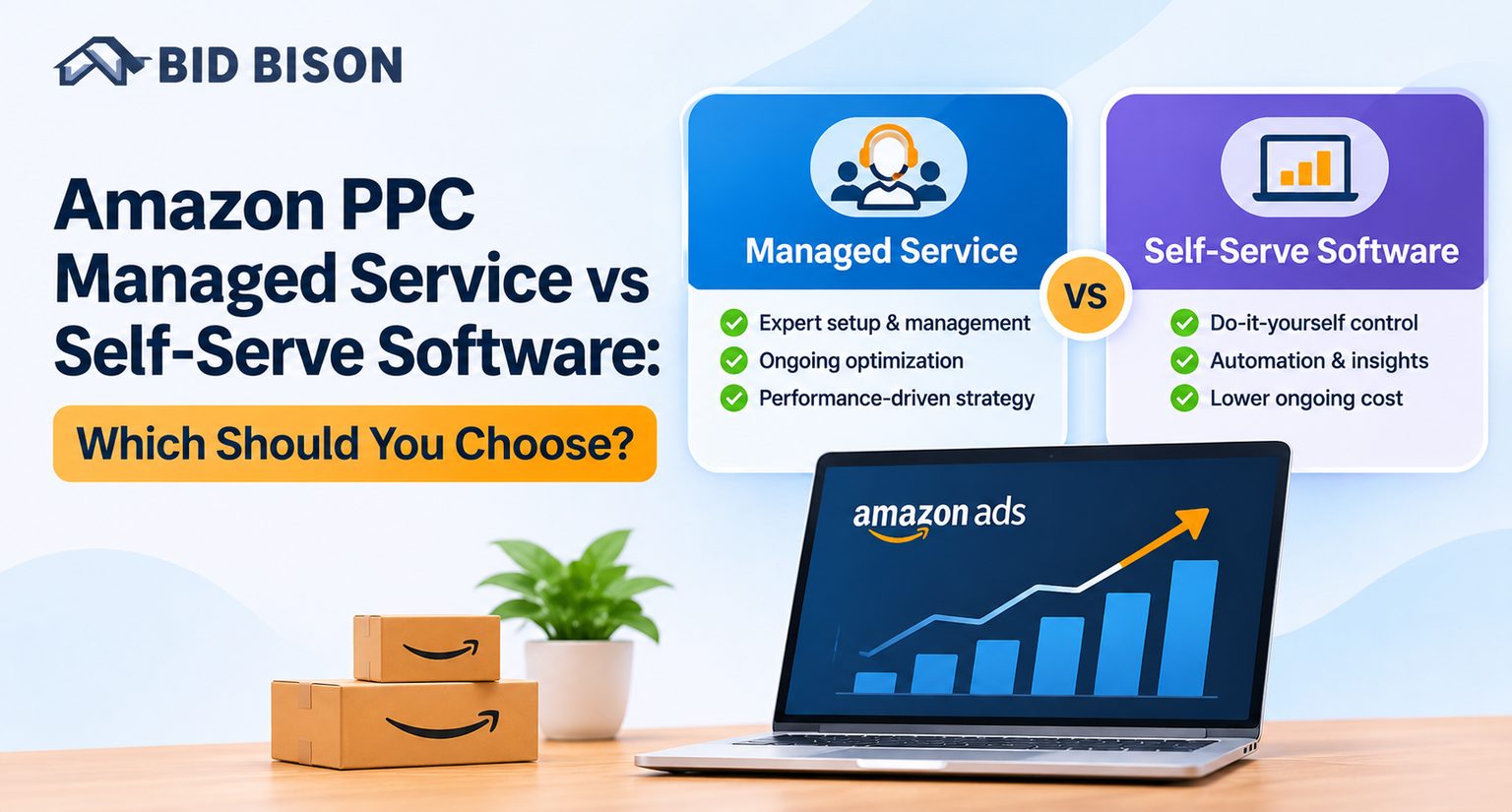
An Amazon PPC managed service costs roughly $1,500 to $7,500 per month as a flat retainer, or 10% to 20% of ad spend. Amazon PPC software costs far less, with BidBison starting at $49 per month. Choose a managed service for hands-off strategy, software for control and lower cost, or a hybrid for scale.
What Is an Amazon PPC Managed Service?
An Amazon PPC managed service is an agency, freelancer or specialist team that plans, launches and optimizes your Amazon ads for a fee. You hand over account access. They handle keywords, bids, budgets, search term reports and performance updates.
A good provider typically covers:
- Campaign structure across Sponsored Products, Sponsored Brands and Sponsored Display
- Keyword research and negative keyword pruning
- Bid and budget changes
- Weekly or monthly reporting
- Strategy calls
An Amazon PPC specialist is the person doing this work. They may sit inside an agency, work as a freelancer, or join your team in-house.
The main benefit is time. You do not need to learn the Amazon Ads console. The main drawback is cost, plus less visibility into daily decisions.
What Is Amazon PPC Software and How Does It Work?
Amazon PPC software is a tool that connects to your Amazon Ads account and automates optimization. It reads campaign data, then adjusts bids, budgets and keywords toward a goal such as a target ACoS.
ACoS (Advertising Cost of Sales) is ad spend divided by ad-attributed sales. A lower ACoS means you pay less in ads for each dollar sold.
Most Amazon PPC automation software follows this cycle:
- It connects through the Amazon Ads API (the official data connection Amazon provides to approved tools).
- It pulls impressions, clicks, spend and sales data.
- It applies rules or AI models to raise, lower or pause bids.
- It finds converting search terms and adds them as keywords.
- It flags wasted spend and sends alerts.
BidBison is Amazon PPC automation software that automates bids, budgets, keywords, dayparting and reporting around your target ACoS. Dayparting means adjusting bids by hour or day, so you spend more when shoppers buy and less when they do not.
An Amazon PPC management tool like this does not replace judgment. You still set goals, margins and product priorities. The software handles the repetitive work around them.
How Much Does an Amazon PPC Managed Service Cost Compared with Software?
Managed services cost $1,500 to $7,500 per month or 10% to 20% of ad spend. Software costs roughly $50 to $250 per month, or a small percentage of spend. Ad spend itself is paid to Amazon in both cases.
Cost Comparison Table
| Cost Factor | Managed Service | Self-Serve Software |
|---|---|---|
| Typical fee | 10%–20% of ad spend, or $1,500–$7,500/month | Roughly $50–$250/month, or 1%–5% of ad spend |
| Pricing model | Retainer, percentage of spend, or hybrid | Flat monthly plan or tiered by spend |
| Setup fees | Common | Rare |
| Contract length | Often 3–6 months | Usually monthly |
| Your time needed | Low | Medium |
| Control and visibility | Medium | High |
Sources for the ranges: Ecombrainly’s 2026 agency pricing guide, SalesDuo’s cost guide and Helium 10’s agency vs automation comparison. BidBison’s self-serve plans run from $49 to $179 per month, flat, with a 14-day free trial. See current plans on the BidBison pricing page.
Worked Example (Illustrative)
A brand spends $20,000 per month on Amazon ads.
- Managed service at 15%: $3,000 per month, or $36,000 per year
- BidBison at $49 per month (one store): $588 per year
The software saves about $35,400 per year in fees. It also asks for more of your time, so count that cost honestly.
How Do the Two Models Differ?
The core difference is who does the work. A managed service gives you a person who makes decisions for you. Software gives you a system that executes decisions at speed, based on goals you set.
Managed Service: Pros and Cons
- Pros: Strategic advice, hands-off operation, human judgment on launches and seasonal events
- Cons: Higher cost, fees that grow with spend, slower reaction time, limited transparency
Self-Serve Software: Pros and Cons
- Pros: Lower cost, 24/7 bid changes, full visibility, no long contracts
- Cons: You must set targets, learn the basics and review reports
Side-by-Side Differences
| Factor | Managed Service | Software |
|---|---|---|
| Speed of bid changes | Daily to weekly | Continuous |
| Strategy input | High | Depends on you |
| Cost at $50K/month spend | $5,000–$10,000+ in fees | A fraction of that |
| Learning curve | Low | Moderate |
| Best for | Hands-off owners | Hands-on owners and teams |
Percentage-of-spend fees also create a built-in conflict. The provider earns more when you spend more, even if profit does not rise. A flat fee or software plan avoids that problem.
Which Model Fits Your Business? Three Seller Scenarios
Match the model to your ad spend, time and PPC skill. The three scenarios below cover the most common seller profiles.
Scenario 1: The New or Small Seller ($1,000–$5,000 Monthly Ad Spend)
Profile: One to five products, tight margins, owner handles everything.
Best fit: Software.
At 15%, a managed service on $4,000 of spend costs $600 per month. Many agencies also set minimum spend thresholds, so small accounts often get less attention. Software from $49 per month gives you automated bids and keyword harvesting without the overhead.
Action: Start a free trial, set a target ACoS equal to your break-even point, and review weekly.
Scenario 2: The Growing Brand ($10,000–$50,000 Monthly Ad Spend)
Profile: 20 or more SKUs, a small team, active launches and promotions.
Best fit: Hybrid.
Fees at this level climb quickly. At $30,000 of spend and a 15% fee, you pay $4,500 per month, according to Helium 10’s cost breakdown. A hybrid keeps software on daily bids and budgets, while a part-time Amazon PPC specialist handles launches, creative and quarterly strategy.
Action: Use software for execution and pay a specialist a flat fee for planning only.
Scenario 3: The Agency or Multi-Account Operator
Profile: Several client accounts, reporting deadlines, thin staff time per account.
Best fit: Software, run by your own specialists.
Manual optimization does not scale across ten or twenty accounts. Automation handles the routine bid and budget work. Your team spends its time on client strategy and reporting. Check the BidBison pricing page or contact the team about multi-account needs.
Action: Standardize target ACoS rules per client, then review exceptions only.
Decision Matrix: Which Management Model Suits Each Business?
Use this matrix to find your model by business type. Find the row that matches your situation, then read across to the recommended option.
| Business Type | Monthly Ad Spend | Your Time Available | PPC Skill Level | Best Model | Why |
|---|---|---|---|---|---|
| New seller, 1–5 products | Under $5K | Moderate | Beginner | Software | Low cost; automates the basics |
| Established small brand | $5K–$10K | Moderate | Intermediate | Software | Control without agency minimums |
| Growing brand, 20+ SKUs | $10K–$50K | Low | Mixed | Hybrid | Software for daily work, specialist for strategy |
| Large brand, multi-marketplace | $50K+ | Very low | Advanced team | Hybrid or managed service | Needs strategy, creative and planning |
| Agency with many clients | Varies | Low per account | Advanced | Software | Scales across accounts |
| Owner with no time and no PPC interest | Any above $5K | Very low | None | Managed service | Full delegation |
| In-house PPC professional | Any | High | Advanced | Software | Replaces manual tasks, keeps control |
Rule of thumb: If agency fees would exceed the profit that better management adds, choose software.
How Do You Choose in Five Steps?
Choose by calculating your break-even ACoS, listing your needs, comparing total cost, testing with a trial, and reviewing results after 30 to 60 days.
- Calculate break-even ACoS. Divide your profit per unit before ad costs by your selling price. Your ACoS should stay under that figure.
- Audit your time and skills. Can you spend two hours per week on reporting and goal-setting? If not, lean toward a managed service or hybrid.
- Add up total cost. Include management fees, setup fees, software fees and your own time.
- Run a trial. Test software free for a few weeks, or ask a managed provider for a short pilot.
- Judge by results. Compare ACoS, total ad sales and TACoS (total advertising cost of sales, which is ad spend divided by all sales, not just ad sales) before and after.
Pro Tips and Common Mistakes to Avoid
These points come from patterns seen across many Amazon accounts: most losses come from set-and-forget habits, not from choosing the wrong model.
Pro Tip: Set a different target ACoS for launch products and mature products. A new listing may run at a higher ACoS to build ranking and reviews. A mature bestseller should be tighter.
Common Mistakes to Avoid
- Choosing by fee alone. A cheap provider that wastes 20% of your spend costs more than an expensive one that does not.
- Skipping the contract details. Check minimum terms, cancellation rules and who owns the account data.
- Never reviewing automation. Software needs correct goals. Check weekly that targets match your margins.
- Ignoring negative keywords. Wasted clicks on irrelevant terms drain budget under any model.
- Judging only on ACoS. A very low ACoS can mean you are under-bidding and losing sales. Watch total sales and TACoS too.
- Outsourcing without access. Always keep admin access to your own Amazon Ads account.
For deeper reading on how Amazon’s ad products work, see the official Amazon Ads site.
Frequently asked questions
How much does an Amazon PPC managed service cost?
How much does Amazon PPC software cost?
Is Amazon PPC software better than a managed service?
What is Amazon PPC software and how does it work?
Can I use software and hire an Amazon PPC specialist together?
Do managed services include ad spend in their fees?
Conclusion
Your Amazon PPC managed service decision comes down to cost, time and control. Managed services suit owners who want full delegation. Software suits sellers who want lower fees and visibility. A hybrid suits growing brands that want both.
Start by calculating your break-even ACoS, then test the software route first. Start a free trial of BidBison and see how automated bids, budgets and dayparting perform against your target ACoS.
Put this into practice automatically.
BidBison runs the strategy for you. 14-day free trial, credit card required.