Rule-Based vs. AI-Driven Amazon PPC: What's the Real Difference (and Which Actually Wins)
Most tools labelled "automated" are really just a set of rules. Here is how the two approaches actually differ, and how to tell which one you're running today.
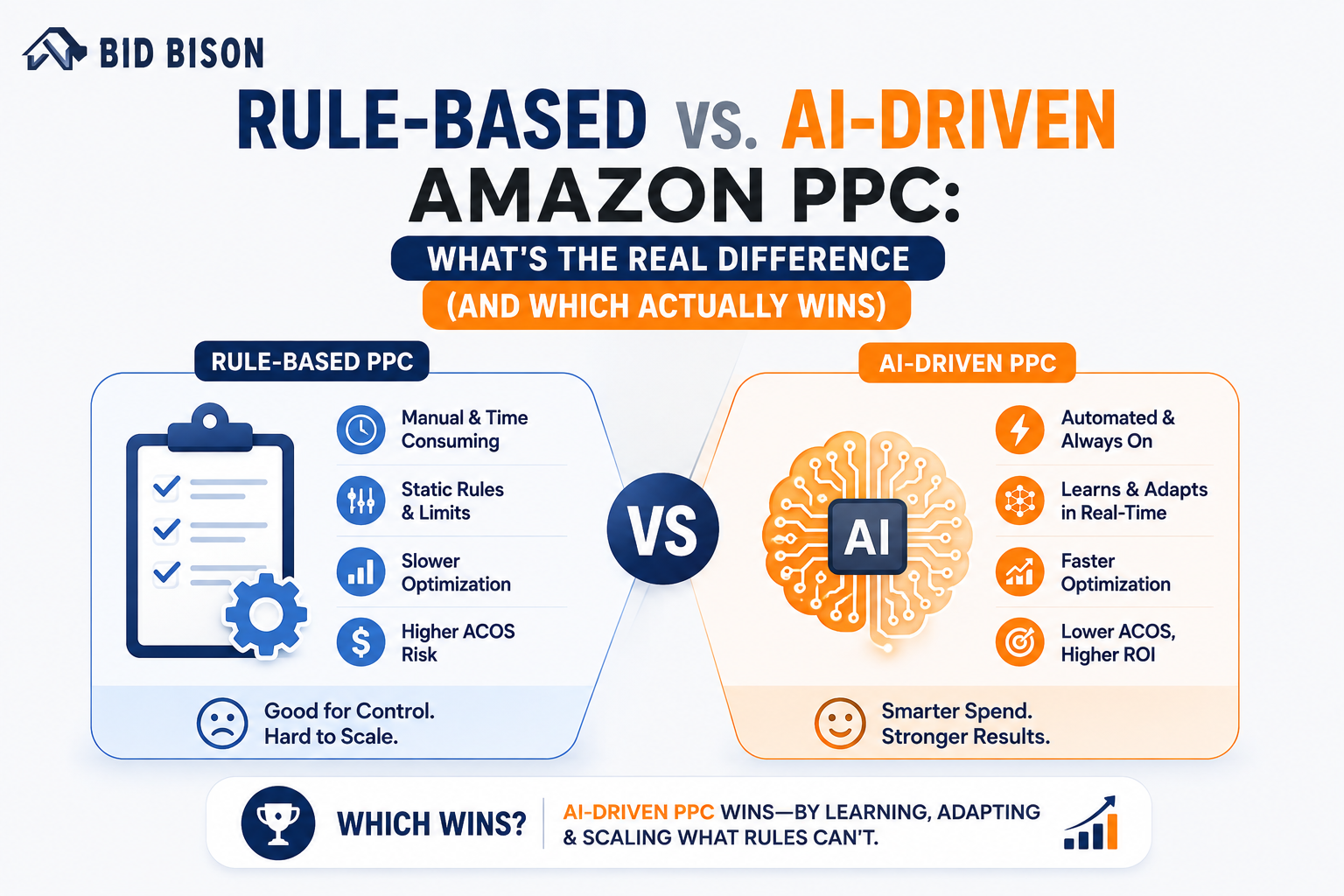
"Automated" is one of the most overused words in Amazon advertising. Almost every PPC tool on the market claims it, yet plenty of sellers using these so-called automated systems still log in daily to check bids, pause keywords, and fix mistakes their "automation" should have caught. That gap between the promise and the reality usually comes down to one thing: most of what's labelled automation is really just a set of rules, not actual intelligence.
There's a real, meaningful split in how Amazon PPC software works today - rule-based automation on one side, AI-driven optimization on the other. They're often marketed as if they're the same thing, but the mechanics behind them are completely different, and that difference shows up directly in your ACOS, your ad spend efficiency, and how many hours you spend managing campaigns instead of growing your business.
In this post, we'll break down how rule-based systems actually work, where they fall short, what AI Amazon PPC software does differently, and how you can tell which one you're actually using today. We'll also look at why this distinction matters more than ever for US sellers heading into an increasingly competitive ad landscape.
What is rule-based Amazon PPC automation?
Rule-based automation is exactly what it sounds like: a set of conditions you (or a tool) define in advance, and the system executes them automatically. Something like, "if ACOS goes above 30%, lower the bid by 10%," or "if a keyword gets 15 clicks with no sales, pause it."
This is the backbone of Amazon's own automated rules feature, and it's also how a lot of third-party Amazon PPC software still operates under the hood, even when it's marketed with more modern language. It's a genuine improvement over manually editing bids one by one in Seller Central. But it has a ceiling, and most sellers hit that ceiling faster than they expect.
The hidden limitations of rules
The core problem with rule-based systems is that they're reactive, not predictive. A rule can only fire after a metric crosses a threshold - which means the money has usually already been spent by the time the system responds. If a keyword burns through budget overnight before your rule triggers, that spend is gone.
Rules also can't factor in context. They don't know it's the Tuesday before a holiday weekend, or that a competitor just dropped their bids, or that a new ASIN launched last week and needs different treatment than your established bestsellers. A threshold that made sense in March might be actively hurting you by August.
And then there's maintenance. Rules go stale. What counts as a "good" ACOS for one product category doesn't apply to another, and as your catalog grows, so does the number of rules you need to babysit. Many sellers end up with rule conflicts - one rule raising a bid while another lowers it - which causes bid oscillation instead of stability.
In short: rule-based Amazon PPC automation removes some manual work, but it doesn't remove the need for you to keep tuning it.
What is AI-driven Amazon PPC software?
AI-driven Amazon PPC software works on a fundamentally different principle. Instead of following static thresholds, it uses machine learning models that continuously analyze historical performance, search term behavior, conversion patterns, and broader market signals - then predicts what bid is likely to perform best, before the outcome plays out.
This is the difference between reacting and forecasting. A rule waits for ACOS to cross 30% before doing anything. An AI Amazon PPC software system is already adjusting bids based on the probability that a keyword or placement will convert, factoring in dozens of signals a static rule was never built to consider.
How AI Amazon PPC software actually works
The engine behind tools like BidBison doesn't rely on a fixed set of instructions. It learns from your account's own data over time - which keywords convert at which times of day, how placements perform across different product categories, how seasonality shifts demand - and adjusts bids accordingly, without you needing to write a new rule every time something changes.
That's the part rule-based tools simply can't replicate: nuance at the keyword and placement level, updated continuously, without manual re-tuning. When Amazon's ad auction shifts - a competitor enters, a seasonal spike hits, a listing's conversion rate changes - an AI-driven system adapts automatically. A rule-based one waits for you to notice and rebuild the logic.
Amazon keyword automation - a practical example
Take keyword harvesting and negation, a core part of any Amazon keyword automation strategy. A rule-based system typically waits for a search term to hit a certain number of clicks or a certain spend threshold before deciding whether to promote it to an exact-match keyword or negate it entirely. That takes time, and in the meantime, budget is either wasted on a losing term or a winning term isn't being pushed hard enough.
An AI-driven system can often identify a converting search term days earlier, based on early conversion signals and pattern-matching against similar historical terms - meaning you capture more sales from a good keyword faster, and cut losses on a bad one sooner.
Rule-based vs. AI-driven PPC - side-by-side comparison
Here's how the two approaches stack up across the factors that actually matter to sellers:
| Factor | Rule-based automation | AI-driven automation |
|---|---|---|
| Setup effort | Requires manually building and tuning rules | Learns from account data with less manual setup |
| Reaction speed | Acts after a threshold is crossed | Predicts and adjusts ahead of outcomes |
| Scalability | Gets harder to manage as SKUs grow | Scales naturally across large catalogs |
| Handling seasonality/spikes | Needs manual rule updates | Adapts automatically to demand shifts |
| Learning curve | Familiar, but plateaus quickly | Steeper at first, compounds over time |
| Long-term ACOS/TACOS trend | Often plateaus or drifts | Tends to improve as the model learns |
| Ongoing maintenance | High - rules need regular review | Lower - the system self-adjusts |
The pattern here is consistent: rules require ongoing human maintenance to stay effective. AI-driven Amazon ads management platforms are designed to need less of that maintenance the longer they run, because they're building an increasingly accurate picture of your account rather than following a fixed script.
Which Amazon PPC management tool actually wins?
Honestly, it depends on where you are as a seller. For very small catalogs, or sellers still in a testing phase who want full manual control over every decision, rule-based tools can be enough. There's less complexity to manage, and the learning curve is short.
But for growth-stage and scaling sellers, AI-driven tools tend to win - specifically on time saved and on ACOS trend over a 60-to-90-day window. If you're managing 20+ campaigns, a multi-SKU catalog, or accounts for multiple clients as an agency, the maintenance burden of rule-based systems grows in direct proportion to your catalog size. AI-driven Amazon PPC software, on the other hand, is built to absorb that complexity rather than multiply your workload.
US Amazon sellers: why this matters now
This isn't just a theoretical debate. US Amazon ad costs have been climbing steadily, with CPC inflation showing up across nearly every major category as more brands compete for the same placements. When cost-per-click is rising month over month, manual or rule-based tuning simply can't keep pace with how fast the market shifts.
Seasonal moments make this even more obvious. Prime Day, Black Friday and Cyber Monday, back-to-school season, and the Q4 holiday surge all create rapid demand swings that reward speed. A rule built for average conditions in June isn't built for the bid war that shows up in November.
Consider a US-based home goods seller scaling from 10 SKUs to 50 ahead of Q4. With a rule-based system, that seller needs to rebuild bidding logic for every new product line, essentially starting from scratch each time. With an AI-driven platform, the system extends what it's already learned about the account and applies it to new SKUs automatically, cutting weeks of manual setup down to days.
There's also a competitive angle worth noting: more US-based aggregators and DTC brands are shifting ad budget onto Amazon, which raises the bar for bid precision across the board. Sellers who are still tuning thresholds by hand are competing against advertisers whose systems are adjusting in real time.
How to tell which type of Amazon PPC software you're using
A lot of sellers assume they're already using AI simply because a tool calls itself "automated." Here's a quick way to check:
- Does it require you to manually set performance thresholds before it can act?
- Does performance improve over time without you making changes, or does it plateau once the rules are in place?
- When a bid changes, does the tool explain why - based on learned patterns - or does it simply log which rule fired?
If the answer leans toward manual thresholds and rule logs, you're likely using rule-based automation dressed up in modern branding. If it's adjusting based on predicted outcomes and improving its own accuracy over time, that's genuine AI-driven bidding.
This is exactly the gap BidBison was built to close - giving sellers an Amazon PPC management tool that actually learns from account performance instead of asking you to keep rewriting the rulebook.
The bottom line
Rule-based automation was a real step forward from manual bidding, but it was never designed to keep up with how fast Amazon's ad auction moves today - especially for US sellers navigating rising CPCs and sharper seasonal swings. AI-driven Amazon PPC software closes that gap by learning from your account instead of waiting for a threshold to trip.
If you're still adjusting bid rules by hand, or watching thresholds fire too late to matter, it might be worth seeing what predictive bidding looks like on your own account. Try BidBison and see how your ACOS trends over the next 30 days - no manual rule-building required. If you'd rather compare options first, our tool comparisons lay out how the main platforms differ.
Is Amazon's built-in "Bid+" or automated rules considered AI?
Will AI Amazon PPC software work for a small catalog (under 20 SKUs)?
How long does AI-driven bidding take to show results?
Can I combine rule-based and AI-driven approaches?
Does AI Amazon PPC software replace the need for a PPC manager?
Stop rewriting the rulebook.
Pick a goal, set a target ACoS, and let BidBison learn your account instead of waiting for a threshold to trip.