Amazon PPC Automation: What It Actually Means and Why Manual Bidding Is Dying
Manual bidding means checking and adjusting bids by hand once or twice a day — while Amazon's ad auctions run every second. Here is what automation actually replaces, and why it matters.
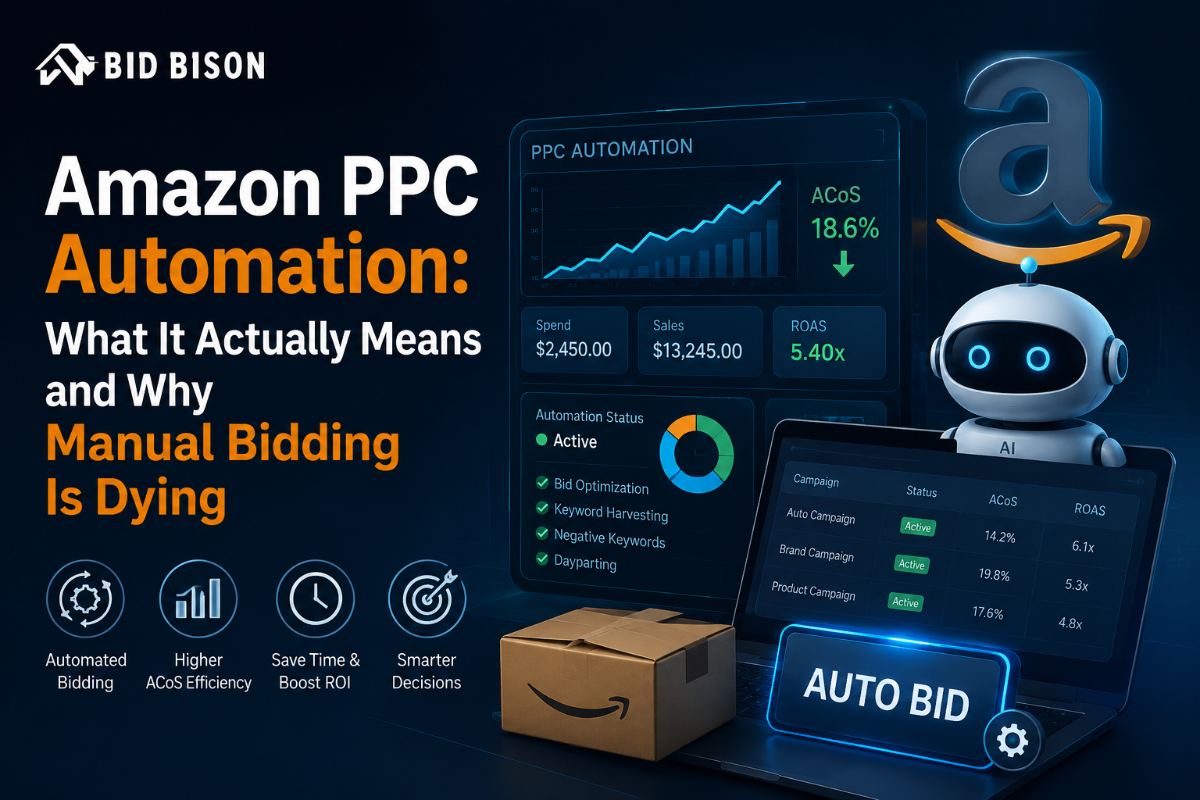
Quick summary: Manual PPC bidding means checking and adjusting bids by hand, once or twice a day, while Amazon's ad auctions run every second. This delay causes overspending, wasted budget on out-of-stock products, and inconsistent ACoS. Amazon PPC automation uses an Amazon PPC AI software to monitor performance 24/7 and adjust bids, budgets, and keywords automatically based on a goal you set. Tools like BidBison replace manual guesswork with a goal-based strategy engine, so ACoS stays in control without daily manual work.
Why are so many Amazon sellers moving away from manual bidding?
Because manual bidding can't keep up with how fast Amazon's ad auctions actually move. Amazon's ad system recalculates bids, competition, and placements constantly. But most sellers only check their campaigns once or twice a day. In that gap, budget gets burned on keywords that already stopped converting, or on products that went out of stock hours ago.
Here's what that gap usually costs sellers:
- Bid overshoot — a keyword looks promising, you raise the bid, it overperforms, and ACoS blows past target before anyone notices.
- Dead spend on out-of-stock products — ads keep running and racking up impressions on a product that can't even sell right now.
- Hours lost every week — pulling reports, building spreadsheets, and manually updating bids one keyword at a time.
- Problems you catch late — by the time you spot an issue in a report, the budget is already gone.
If any of this sounds familiar, you're not managing PPC. You're reacting to it.
What does Amazon PPC automation actually mean?
Amazon PPC automation means a system manages your bids, budgets, and keywords on its own, based on a goal you set — instead of you manually adjusting them every day. This is exactly what an Amazon PPC AI software does. It watches your account's real-time performance — sales, spend, conversions, placement — and decides on its own when to raise a bid, when to pull it back, and when to leave it alone.
Here's the practical difference:
- Manual approach: You set a target ACoS of 20%, then check daily and adjust bids yourself when performance drifts.
- Automated approach: You set the same 20% target once, and the software holds bids inside that range continuously — including overnight, and across every campaign at once.
One requires your attention every day. The other requires it once.
Manual vs automated bidding: side-by-side
| Factor | Manual bidding | Automated (AI) bidding |
|---|---|---|
| Monitoring | Once or twice a day | Continuous, around the clock |
| Reaction speed | Slow — hours behind | Immediate |
| Consistency | Depends on the person doing it | Rule-based and repeatable |
| Scale | Realistic for a handful of keywords | Handles hundreds of keywords at once |
| Time cost | Daily manual work | Set once, monitor occasionally |
At 10–15 products, manual bidding is annoying but survivable. Past that, it stops being a strategy and starts being a full-time job nobody signed up for.
Why do sellers need an Amazon ads management platform?
Because running multiple ad types across a growing catalog is impossible to track from Seller Central alone. Once you're running Sponsored Products, Sponsored Brands, and Sponsored Display together — maybe across more than one marketplace — checking each one separately eats up your day before you've optimized anything.
A proper Amazon ads management platform solves this by putting everything on one screen:
- Daily spend, sales, ACoS, and RoAS trends in one view
- Product-level performance tied to individual ASINs
- Current period vs. previous period comparisons, without building your own spreadsheet
This isn't a nice-to-have once your catalog grows. It's the only way to actually see what's happening across your account.
How does Amazon keyword automation save time?
It finds converting search terms and blocks wasteful ones automatically, instead of you digging through reports by hand. Amazon keyword automation scans your Auto and Broad campaign search term reports continuously, and:
- Surfaces search terms that are already converting, so you can promote them to exact or phrase match
- Flags search terms burning budget with zero orders, and adds them as negatives in bulk
- Shows you the real shopper language behind every keyword — not just guesses
What used to take hours of manual review every week happens automatically, in the background.
Should you use an Amazon PPC management tool or hire a consultant?
It depends on whether you want control or hands-off management — both are valid, based on how involved you want to stay.
- A self-serve Amazon PPC management tool: You set the goal — maintain ACoS, scale winners, clear stock — and the tool executes it continuously. Best for sellers who want control without doing the daily manual work.
- An Amazon PPC consultant (UK or your region): A dedicated specialist manages the account for you — strategy, bids, keywords, reporting — while you stay updated through regular reviews.
Neither is "better." One replaces your daily task list; the other replaces the need to have one at all.
Why does Amazon PPC automation matter especially for UK sellers?
Because UK sellers often run ads across multiple marketplaces at once, and manually tracking each one separately isn't realistic. Amazon PPC automation UK matters because sellers here frequently manage US, UK, AU, and CA marketplaces together — each with its own currency, competition level, and customer behavior. Automation applies the same consistent strategy across all of them without requiring a separate manual login and check-in for each one.
How BidBison actually replaces the manual bidding grind
Instead of building rules from scratch, BidBison works off a goal-based strategy engine. You pick the outcome you want, and the system runs it:
- Get found fast — chases impressions and rank for new products without killing keywords too early
- Maintain ACoS — holds bids inside your target band on steady products
- Scale winners — pushes budget into keywords that already convert, trims the rest
- Reduce ACoS — defends margin hard when budget is tight
- Clear stock — moves aging inventory without dropping below your break-even point
Two things make this different from just "auto-bidding":
- Anti-oscillation logic — bids stay inside an acceptable band instead of bouncing up and down every day, which is the exact problem manual bidding creates.
- Proactive alerts — you get flagged the moment something goes wrong: Buy Box lost, an out-of-stock product still spending, or a campaign Amazon has rejected — not three days later when the damage is done.
If you'd rather not run it yourself, BidBison's managed service puts a certified eStore Factory specialist on your account, with the same live dashboard so you always see what's happening.
What is Amazon PPC AI software?
Why is manual Amazon PPC bidding becoming outdated?
What does an Amazon ads management platform do?
How does Amazon keyword automation improve campaign performance?
Should I choose an Amazon PPC management tool or an Amazon PPC consultant UK?
Is Amazon PPC automation suitable for UK sellers?
Can Amazon PPC AI software reduce ACoS?
Why should I use BidBison for Amazon PPC automation?
Stop checking Seller Central every night.
Set your target ACoS once, and let the strategy engine take it from there. Free during launch, no card required.