Dayparting for Amazon Ads: Does Bidding by the Hour Actually Work?
Amazon gives you no native ad scheduling. So is hourly bidding a real ACOS lever, or a tactic that sounds smarter than it performs? Here is what the data usually shows.
If you've ever pulled up your Amazon PPC dashboard at 2 a.m. and noticed your ads are still burning through the budget with barely a sale to show for it, you've probably had the same thought a lot of sellers have: shouldn't my bids be lower right now?
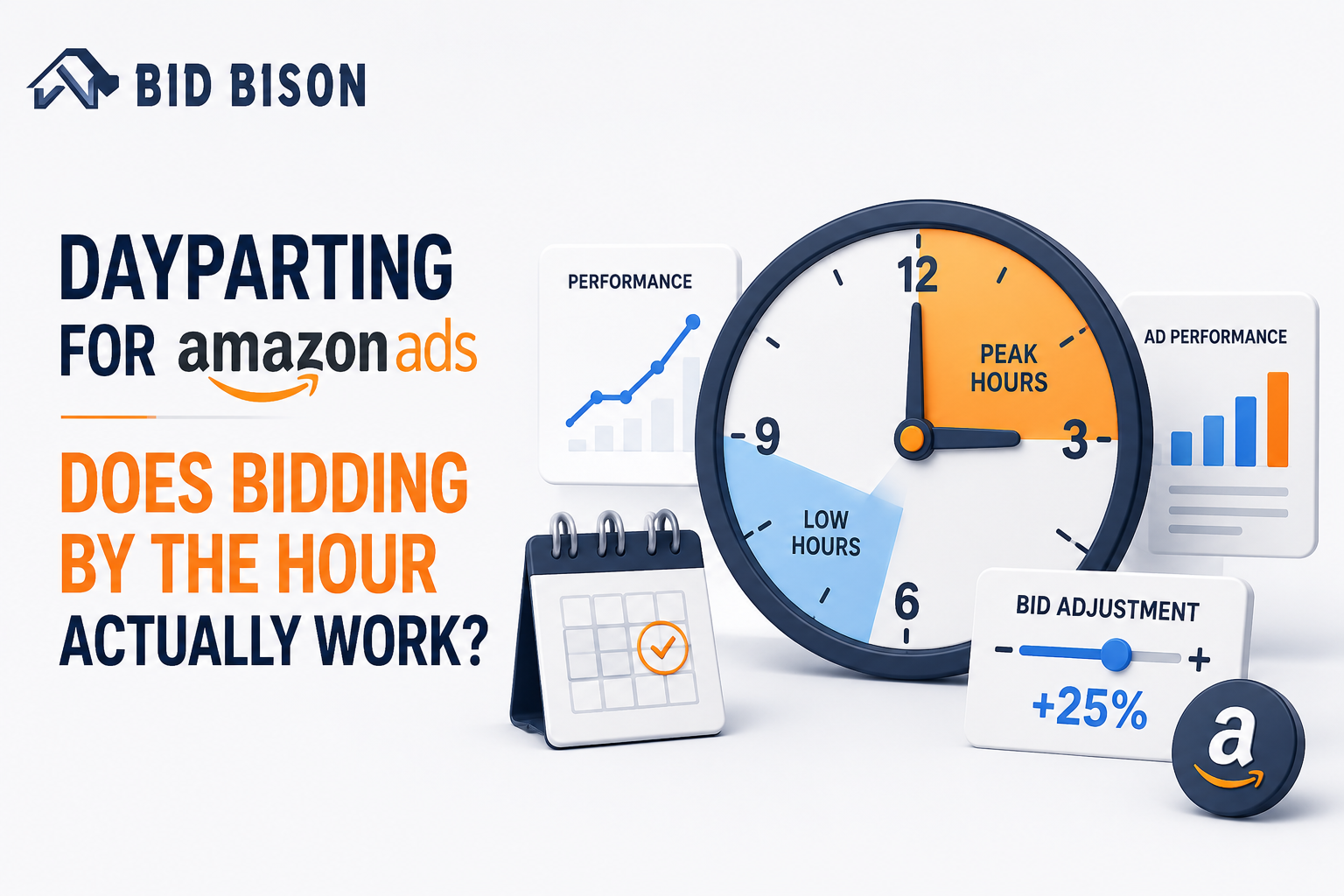
That thought is the entire idea behind dayparting - adjusting your bids up or down depending on the hour of the day (and sometimes the day of the week) instead of running one flat bid around the clock. It's a tactic borrowed from Google Ads, where "ad scheduling" has been a standard feature for years. Amazon Ads, however, doesn't offer anything like it natively. There's no toggle in Seller Central that says "lower bids overnight." If you want to bid by the hour, you either have to build it yourself or use Amazon PPC automation software that does it for you.
So does it actually work? Is dayparting a meaningful lever for cutting ACOS, or is it one of those tactics that sounds smart in a blog post but barely moves the needle in practice? In this article, we'll look at the theory, what the data tends to show, why manual dayparting is harder than it sounds, and how AI Amazon PPC software like BidBison handles it automatically.
What is dayparting in Amazon PPC?
Dayparting means adjusting your keyword or campaign bids based on the time of day (and often the day of the week) rather than leaving them static 24/7. The logic is simple: if your ads convert well between 6 p.m. and 10 p.m. but barely convert between 1 a.m. and 5 a.m., why bid the same amount during both windows?
It's worth separating dayparting from two related - but different - tactics:
- Placement adjustments change your bid based on where your ad shows up (top of search, product pages, rest of search). Dayparting changes your bid based on when it shows up.
- Day-of-week bidding is a broader version of dayparting - adjusting bids for, say, weekends versus weekdays, rather than hour by hour.
The important thing to understand up front: Amazon Ads has no built-in scheduling feature for any of this. Every hourly bid change has to be done manually through Bulk Operations, through the API, or through an Amazon ads management platform that automates it.
The theory: why hour-of-day could affect Amazon ad performance
Before getting into whether dayparting works, it helps to understand why it might work in the first place.
Shopper behavior patterns by hour
Not all browsing is buying. A shopper scrolling Amazon at midnight on their phone is often window-shopping, comparing options, or adding things to a wish list. That same shopper checking Amazon on their lunch break, or in the evening after dinner, is frequently in a "ready to buy" mindset. Conversion rates - not just traffic - shift by hour, and that's the piece that actually matters for ad efficiency.
Device usage matters too. Mobile traffic tends to spike during commute hours and evenings, while desktop traffic often holds steadier during the workday. Since mobile and desktop shoppers don't always convert at the same rate, this shift alone can move your numbers hour to hour.
Competitive bidding patterns
You're not the only seller thinking about this. During standard US business hours, more advertisers are actively logged in, adjusting bids, launching campaigns, and reacting to dashboards - which can nudge CPCs upward. Overnight, with fewer advertisers actively managing bids, competition (and cost) can ease off, even if your own conversion rate also dips.
Where the theory breaks down
Here's the honest part: this pattern is real, but it's easy to overestimate. If you're only getting a handful of orders a day, breaking that data down into 24 hourly buckets leaves you with almost nothing to analyze in each bucket. A single lucky (or unlucky) hour can look like a "pattern" when it's really just noise. Dayparting works best when there's enough order volume to actually see a trend - not when you're trying to read tea leaves from three sales a day.
What the data actually shows: does dayparting work?
The honest answer is: dayparting produces real but modest gains for most Amazon sellers - not a dramatic ACOS transformation. It's a refinement, not a silver bullet. Where it tends to help is in shaving inefficiency off the edges: reducing spend during low-converting overnight hours and, sometimes, pushing slightly harder during your proven peak windows.
Dayparting tends to work best when:
- You're running high-volume campaigns or ASINs with enough hourly order data to see a genuine, repeatable pattern (not just a one-day fluke)
- Your category has naturally strong time-of-day behavior - think mealtime-related products, alcohol and beverages, or impulse and gift categories where evening and weekend browsing spikes are well documented
- You're already managing a mature account and looking for incremental efficiency, not trying to fix a fundamentally underperforming listing
Dayparting tends not to move the needle when:
- You're advertising long-tail keywords or a newly launched listing that simply doesn't have enough daily orders to produce statistically meaningful hourly data
- Your category has flat, consistent demand all day (some B2B-adjacent and everyday-essential categories show very little hour-to-hour variation)
- You're hoping dayparting will fix a listing problem - poor conversion rate, weak images, uncompetitive pricing - that has nothing to do with timing
The US time zone complication
Here's a wrinkle that's specific to selling in the United States: a national ad campaign spans four time zones. "Peak evening browsing" at 8 p.m. Eastern is only 5 p.m. Pacific - still the tail end of the workday on the West Coast. If you set your dayparting rules around Eastern Time and apply them account-wide, you may be raising bids for East Coast evening shoppers while simultaneously mistiming your West Coast audience entirely.
This is one of the most overlooked pieces of dayparting for US sellers. It also explains why hourly bidding tends to work better as an aggregate account-wide pattern (based on Amazon's own server-time reporting) rather than something sellers try to hand-tune by geography - that level of precision is genuinely hard to manage manually.
Seasonal US shopping moments add another layer. During Prime Day, Black Friday, and Cyber Monday, hourly behavior compresses and intensifies - spikes that might unfold over an evening on a normal day can happen within a 90-minute window during a flash sale. Static, pre-set dayparting rules built for a "normal Tuesday" can actually work against you during these events unless they're being adjusted in near real time.
The manual dayparting problem
This is where most sellers who try dayparting run into a wall. Amazon's Bulk Operations spreadsheets are built for periodic bid updates, not scheduled hourly changes. There's no "set it and forget it" scheduling function. If you want true hourly bidding, you're looking at one of two options:
- Manually updating bids throughout the day, every day, including weekends - which is not a realistic workload for anyone managing more than a handful of campaigns
- Writing your own script against the Amazon Ads API - which requires development resources most sellers and agencies don't have sitting around
Even sellers who commit to the manual route usually run into the same failure points: missed windows when someone forgets to make the change, no weekend coverage because nobody wants to update bids on a Saturday night, and simple human error from copying the wrong bid into the wrong campaign at 11 p.m.
This operational reality is really the whole argument for automation. Dayparting isn't complicated in theory. It's complicated to execute consistently, at scale, without a system doing it for you.
How AI Amazon PPC software automates dayparting
This is where Amazon PPC automation software earns its keep. Instead of a human trying to remember to change bids every few hours, the software watches performance continuously and adjusts on its own.
Rule-based vs AI/algorithmic bid automation
- Rule-based automation applies fixed instructions, like "lower all bids by 20% between midnight and 6 a.m." This is better than nothing, but it's static - it doesn't adapt if your conversion pattern shifts, and it treats every campaign the same regardless of how much data actually supports that rule.
- AI-driven automation, which is how BidBison approaches it, continuously analyzes hourly conversion rate, ACOS, and CPC trends at the campaign and keyword level, then adjusts bids based on what the data is actually showing - not a one-size-fits-all schedule set once and forgotten.
The difference matters because Amazon PPC accounts are never static. A keyword's peak hour in January might not be its peak hour in July. Rules set once tend to go stale; algorithmic bidding keeps recalculating.
What a good Amazon ads management platform should offer for dayparting
If you're evaluating Amazon PPC automation software - whether that's BidBison or another AI Amazon PPC software - for dayparting specifically, a few capabilities separate the useful tools from the basic ones:
- Granular hourly and day-of-week reporting - you should be able to see performance broken down by hour, not just view a black-box "optimized" bid
- Bid rules genuinely tied to conversion data, not arbitrary time blocks that someone guessed at
- Guardrails, like minimum and maximum bid caps, so the system doesn't overcorrect during a low-data test window and either overspend or go invisible
- Time-zone awareness for national US campaigns, so hourly adjustments actually reflect when your real customers - across all four US time zones - are browsing and buying
Manually checking hourly performance and adjusting bids one campaign at a time isn't something most sellers can sustain long-term. BidBison's Amazon ads management platform handles this in the background, using real conversion data with built-in guardrails, so bids adjust without someone needing to babysit a spreadsheet every few hours.
How to test dayparting for your own Amazon listings
If you want to find out whether dayparting is worth it for your own catalog before committing to it long-term, here's a straightforward way to test it:
- Pull hourly performance data first. Use your Sponsored Products search term and placement reports to look at conversion rate, ACOS, and spend broken down by hour, over at least 30-60 days. Anything shorter and you're likely looking at noise, not a trend.
- Check for statistically meaningful patterns. Look for hours with enough order volume to trust the numbers - not just one hour that happened to convert well twice.
- Start with modest adjustments. Rather than slashing bids 50% overnight, start with something like a 10-15% adjustment up or down. Aggressive swings make it harder to tell what's actually working versus what's just volatility.
- Run it for a full cycle and compare. Let the adjustments run through at least one full week - including weekends, since weekend shopping behavior is often meaningfully different - and compare ACOS and TACOS before and after.
If you're doing this manually, expect it to take real time each week. If you're using an AI Amazon PPC software platform, this testing process is largely automatic - the system is already tracking hourly performance and adjusting continuously, which is really the point of using one in the first place.
Dayparting in the UK/EU vs the US
Sellers running Amazon PPC automation in the UK face a similar core problem: Amazon UK also has no native ad scheduling feature, so hourly bid changes require the same manual effort or the same reliance on automation software. The peak windows themselves look a bit different - UK evening browsing tends to cluster a bit earlier relative to typical US evening peaks - but the bigger practical difference is simplicity. A UK campaign runs in a single time zone, which removes the multi-time-zone complexity that makes US dayparting trickier to manage by hand. Sellers running Amazon PPC automation UK campaigns still benefit from the same kind of AI-driven, conversion-based bidding - just with one less variable to account for.
Final thoughts: is dayparting worth it?
Dayparting isn't a magic fix, and it's not going to turn a struggling listing into a bestseller. But for accounts with enough order volume to see a real pattern, it's a legitimate way to trim inefficiency - spending less during hours that rarely convert and holding steady (or pushing a bit harder) during the hours that actually drive sales. The catch is that Amazon simply doesn't give you the tools to do this natively, and doing it manually, hour after hour, day after day, isn't realistic for most sellers.
That's really the gap that Amazon PPC automation software is built to close. Instead of trying to remember to change bids at 6 a.m. and again at 10 p.m., an AI Amazon PPC software platform like BidBison watches the data continuously and adjusts on your behalf, with guardrails so the automation doesn't run wild. If you've been curious whether hourly bidding could tighten up your ACOS, the easiest way to find out is to let the data run for a few weeks rather than trying to guess.
Does Amazon Ads support native dayparting or ad scheduling?
How much can dayparting actually reduce ACOS?
Is dayparting worth it for small or new Amazon sellers?
What's the difference between dayparting and day-of-week bidding?
Can I daypart manually without software?
How does BidBison handle hourly bid automation?
See where your ad spend goes by the hour.
BidBison watches hourly conversion data and adjusts bids with guardrails - no spreadsheet required. 14-day free trial, credit card required.