Amazon Ads Management Platform vs. Amazon PPC Managed Service: Which Fits Your Business?
Software, a specialist, or both? Compare cost, control and time to find the right fit for your business.
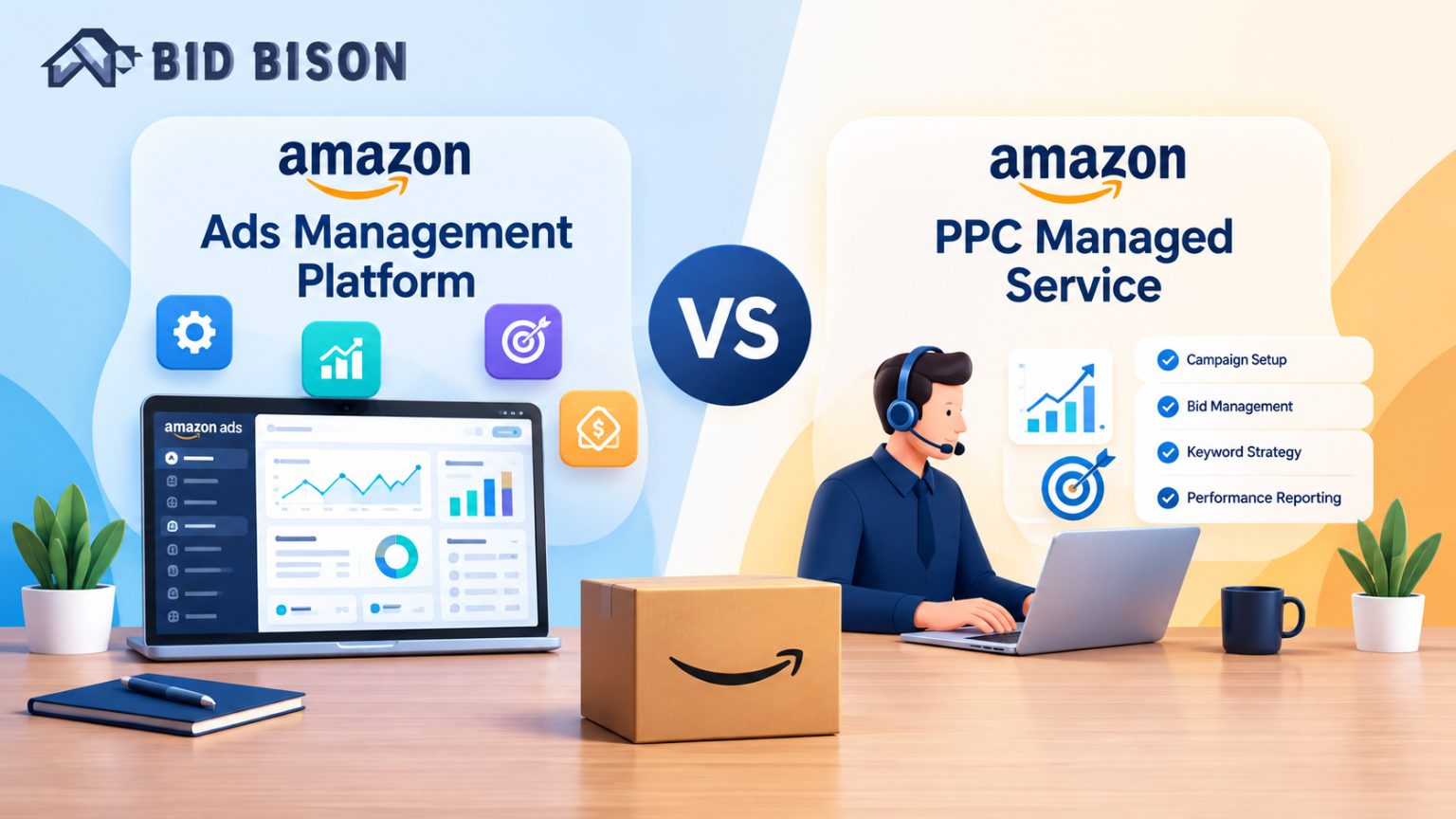
Running Amazon ads is a balancing act. Bids need constant adjustment, search terms need review, and budgets need protecting, all while you handle inventory, listings, and customer service. At some point, most sellers ask the same question: should I use software, or should I hire someone to do it for me?
The short answer: An Amazon ads management platform suits sellers who want control and have a few hours a week to spare. An Amazon PPC managed service suits sellers who want an expert to run everything. Many businesses get the best results from a mix of both.
This guide breaks down how each option works, what it costs, and how to choose with confidence.
Quick Answer: Platform or Managed Service?
Use this cheat sheet before reading further:
- Pick a platform if you want hands-on control, predictable costs, and the ability to scale across several stores or clients.
- Pick a managed service if you have limited time, larger ad spend, and no in-house PPC expertise.
- Pick a hybrid if you want a specialist to run your ads while you keep full visibility in a live dashboard.
What Is an Amazon Ads Management Platform?
An Amazon ads management platform is software that connects to your Amazon Advertising account and automates the repeated decisions behind your campaigns, such as bids, budgets, keywords, and negative terms. It uses your own performance data to steer results toward a goal like a target ACoS.
You may also see this category called Amazon PPC software. The names differ, but the idea is the same: the tool does the routine work, and you set the direction.
How Does Amazon PPC Software Work?
Most tools follow a similar loop:
- You connect your Amazon Advertising account.
- You choose a goal, such as launching a product, holding profit margin, or scaling winners.
- The software reviews performance on a schedule and adjusts bids and budgets.
- It finds converting search terms and flags wasteful ones.
- You review reports and change direction when your business changes.
What Can a Platform Automate?
- Bid management: raising or lowering bids to stay near your target ACoS
- Keyword harvesting: moving proven search terms from Auto and Broad campaigns into Exact or Phrase campaigns
- Negative keywords: blocking terms that spend without converting
- Day parting: reducing bids at low-converting hours and increasing them at peak times
- Alerts: warning you about lost Buy Box, out-of-stock products still spending, or rejected campaigns
Who Benefits Most?
Platforms work well for owner-operators, in-house marketers, and agencies. For agencies especially, Amazon advertising agency software reduces the manual hours per client, which lets a small team manage more accounts without losing quality.
What Is an Amazon PPC Managed Service?
An Amazon PPC managed service is a done-for-you arrangement where a specialist or team plans, launches, and optimizes your Amazon campaigns. You pay for expertise and time rather than just access to a tool.
You might also hear it called a paid search management service. Whatever the label, the core promise is the same: a professional takes responsibility for your ad performance.
What Does a Managed Service Usually Include?
- A dedicated Amazon PPC specialist assigned to your account
- Strategy built around your goals, such as launch, profit, growth, or clearance
- Ongoing optimization of bids, keywords, and negatives
- Regular reviews and performance reports
- Advice that connects ads to the rest of your Amazon business
Who Benefits Most?
Brands with meaningful ad spend and little internal capacity. If nobody on your team has the time or experience to manage PPC daily, a managed service can be faster and safer than learning through trial and error.
Platform vs. Managed Service: Key Differences
| Factor | Management Platform | Managed Service |
|---|---|---|
| Who runs the ads | You or your team | A dedicated specialist |
| Level of control | High | Shared |
| Your time commitment | A few hours per week | Minimal |
| Expertise needed | Basic to moderate | None |
| Typical cost | Lower, subscription-based | Higher, service-based |
| Transparency | Full, you see everything | Depends on the provider |
| Best for | Hands-on sellers and agencies | Busy brands with larger budgets |
How Much Does Each Option Cost?
Cost often decides the matter, but the sticker price tells only part of the story.
Platform Pricing
Platforms generally charge a monthly subscription, often scaled by the number of stores or marketplaces you manage. Since software does the heavy lifting, you are not paying for specialist hours. For example, BidBison self-serve plans range from $49 to $179 per month depending on the number of stores and countries.
Managed Service Pricing
Managed services charge for expertise. Common models include a flat monthly fee, a percentage of ad spend, or a mix of the two. Percentage-based fees can climb quickly as your budget grows, so ask how pricing changes when you scale. BidBison's Done for You service is a flat $499 per month with the platform included.
Do Not Forget the Cost of Your Time
A cheap tool that nobody uses delivers poor results. An expensive service that frees you to focus on products and growth may pay for itself. When comparing options, count the hours you would realistically spend each week.
Which Option Fits Your Business?
Match your situation to the profiles below.
You Should Choose a Platform If:
- You can set aside a few hours a week to set goals and review results
- You want direct control over strategy
- You manage several stores, marketplaces, or client accounts
- You prefer lower, predictable monthly costs
- You like seeing exactly what changed and why
You Should Choose a Managed Service If:
- Your team has little capacity for PPC
- Your ad spend is large enough to justify dedicated management
- You lack Amazon advertising experience in-house
- You want one accountable specialist
- You would rather review summaries than campaign data
You Should Consider a Hybrid If:
- You want expert management without losing visibility
- You may want to start with a specialist and take over later
- You want your reporting in one dashboard no matter who runs the ads
Common Mistakes When Choosing
Choosing on Price Alone
The cheapest option is rarely the best. Weigh the price against the time you will spend and the results you need.
Expecting Overnight Results
Amazon's 14-day attribution window means sales data takes time to settle. Judging performance after a few days counts full spend against incomplete sales. Give any new setup two to three weeks before reading the ACoS trend.
Accepting a Black Box
Whether it is software or a service, you should be able to see what changed and why. Without transparency, you cannot trust results or learn from them.
Overlooking Inventory and Buy Box Problems
Ads that keep running on out-of-stock products, or on listings where you have lost the Buy Box, burn budget quickly. Choose a solution that monitors these issues and alerts you right away.
What to Look for in an Amazon PPC Specialist Tool
If you lean toward software, a good Amazon PPC specialist tool should do more than apply basic bid rules. Look for these features.
Goal-Based Strategies
Instead of forcing you to build complex rules, the tool should let you pick an outcome: launch a new product, hold a target ACoS, scale winners, cut ACoS, or clear stock.
Stable Bidding Logic
Bids that swing up and down every day create unpredictable results. Choose software with logic that keeps bids inside a sensible range.
Custom Rules When You Need Them
Presets save time, but advanced users should be able to build their own logic, such as adding a search term as a negative after 50 clicks and zero orders in 14 days, without writing code.
Broad Ad Type and Marketplace Coverage
The tool should support Sponsored Products, Sponsored Brands, Sponsored Display, and Sponsored TV in the marketplaces you sell in.
Clear Reporting and Proactive Alerts
You should see spend, sales, ACoS, and RoAS by match type, placement, campaign, and ASIN, plus alerts for issues that quietly drain budget.
The Hybrid Option: How BidBison Supports Both Paths
You do not have to treat this as an either-or decision. BidBison offers two paths that use the same strategy engine and the same live dashboard.
Self-serve: You choose a goal, set your target ACoS, and BidBison manages bids, budgets, day parting, and keyword harvesting around the clock. It works inside your current campaign structure, logs every change, and does not overwrite manual bids you set. Every plan begins with a 14-day free trial that includes all features.
Done for You: If you would rather hand it off, a dedicated Amazon PPC specialist runs your strategy, bids, keywords, and negatives inside BidBison. You still see every move in the dashboard, so there is no mystery about where your budget goes.
Because both options live in one platform, you can start on your own and add expert support later, or begin with a specialist and take control when you are ready, without changing tools or losing data.
Frequently asked questions
What is the difference between an Amazon ads management platform and a managed service?
Is Amazon PPC software worth it for small sellers?
How long does Amazon PPC automation take to show results?
Can agencies use Amazon advertising agency software?
When should I move from a platform to a managed service?
Does a managed service replace the need for software?
Final Thoughts: Choose the Model That Matches Your Reality
The best Amazon advertising setup is the one you will actually keep up with and trust. If you have time and want control, an Amazon ads management platform is a strong, cost-effective choice. If you need expert hands and have the budget, an Amazon PPC managed service removes the workload. And if you want both, a hybrid keeps you informed while a specialist does the heavy lifting.
Whatever you choose, look for goal-based strategy, stable bidding, proactive alerts, and full transparency. Those are the building blocks of profitable Amazon ads.
Ready to Simplify Your Amazon Advertising?
Try BidBison free for 14 days with every feature included, or talk to the team about having specialists run your ads for you. Start your free trial with BidBison
Self-serve or Done for You, one dashboard.
Start on your own and add a specialist later, without changing tools or losing data. 14-day free trial, credit card required.