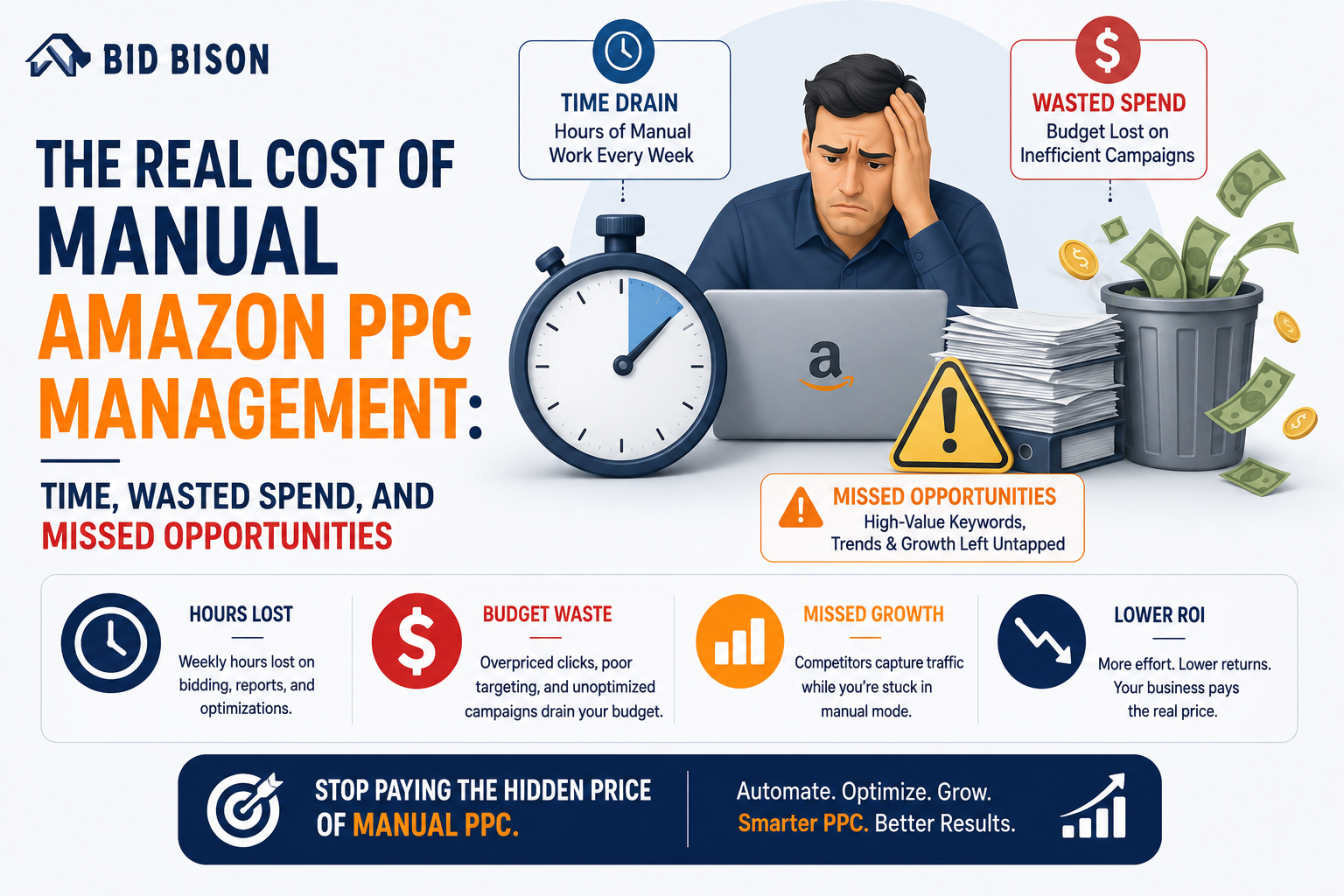
The Real Cost of Manual Amazon PPC Management: Time, Wasted Spend, and Missed Opportunities
DIY PPC isn't free - it's unbilled. Here is where the cost actually hides, and the signals that say it's time to hand the account to someone whose full-time job it is.
Ever found yourself adjusting Amazon bids at 11 p.m. because "that's the only quiet time you get"? You already know something about PPC management that most articles don't say out loud: it's not actually free. It just feels free, because the cost shows up as your time instead of a line item on an invoice.
For US-based Amazon sellers, that trade-off is getting harder to ignore. Ad costs on Amazon.com keep climbing, competition from new sellers entering the marketplace is fiercer than ever, and Seller Central's tools, while useful, weren't built to run a full-scale advertising strategy on their own. So a lot of sellers end up in the same spot: spending hours a week on PPC, still watching ACoS creep in the wrong direction, and wondering whether there's a better way.
This is where working with an experienced advertising agency for Amazon starts to make a lot more sense than it might have a year or two ago. Not because manual management is impossible - plenty of sellers do it - but because the actual cost of doing it yourself is usually higher than it looks. In this article, we'll break down the three places that cost hides: time, wasted ad spend, and missed opportunities, and talk about how a managed service like BidBison approaches things differently.
Why manual Amazon PPC management feels cheaper than it is
There's no invoice for "40 hours of my own time this month," so it's easy to assume DIY PPC is the budget-friendly option. But time isn't free - it's just unbilled. Every hour spent adjusting bids or digging through search term reports is an hour not spent sourcing new products, improving listings, or talking to customers.
Manual PPC management usually looks something like this: logging into Seller Central a few times a week, scanning campaign performance, tweaking bids up or down based on gut feel, adding a few negative keywords when something obviously isn't converting, and maybe pausing an underperforming ad group. It's reactive by nature - you're responding to what already happened instead of steering the campaign proactively.
That reactive approach isn't a personal failing. It's just what happens when PPC is one of fifteen things on a seller's plate instead of the only thing on someone's plate.
Cost 1: the real time investment of DIY PPC
Ask most sellers how much time they spend on PPC and you'll often get an answer that's lower than reality, because a lot of that time is scattered across the week in 15-minute chunks that don't feel like "work," but add up fast.
Industry estimates commonly put meaningful PPC management - checking dashboards, adjusting bids, reviewing search terms, building out negative keyword lists, testing new campaigns - at several hours per week, even for a single-marketplace account with a modest catalog. For sellers running more SKUs or expanding into new categories, that number climbs quickly.
Here's the real question: what would that time be worth doing something else?
Take a US seller doing around $50,000 a month in Amazon revenue, spending 8-10 hours a week on PPC. That's roughly 35-40 hours a month - nearly a full work week - going toward campaign management instead of product development, supplier negotiations, or customer experience. For a solo seller or a two-person team, which describes a huge share of the US Amazon seller base, that opportunity cost is significant. There's no marketing department to absorb it; it's coming directly out of the owner's or a key employee's bandwidth.
Compare that to working with a paid search management service where a dedicated specialist owns the campaigns daily. The hours don't disappear - they just move to someone whose full-time job is optimizing Amazon ads, freeing the seller to focus on growing the business itself.
Cost 2: wasted ad spend from manual management
This is usually the cost sellers feel the most, even when they can't always name it. Wasted spend doesn't show up as one big mistake - it shows up as a slow leak that's easy to miss when you're checking in a few times a week instead of monitoring daily.
Some of the most common manual-management mistakes include:
- Overusing broad match keywords without tight enough negative keyword lists, which lets budget flow toward irrelevant searches.
- Delayed reaction to search term reports, so a keyword that's been burning spend for two weeks doesn't get flagged until the next check-in.
- Bid decisions based on gut feel rather than data trends, which can mean overspending on keywords that already peaked or underbidding on ones that are just starting to convert well.
- Ignoring dayparting and placement data, missing the fact that certain hours or placements convert far better than others.
This gets worse during high-stakes periods. Prime Day, Black Friday and Cyber Monday, and the general Q4 holiday surge are exactly when competition - and CPCs - spike across Amazon.com. A campaign that's only checked twice a week can bleed budget fast during a week when competitors are adjusting bids hourly. The same goes for back-to-school season in categories where that surge is predictable but easy to underprepare for.
While exact numbers vary by category and account size, it's common for accounts without dedicated, daily optimization to waste a meaningful share of their ad budget on non-converting search terms, mistimed bids, or placements that never should have been running. Even a modest reduction in wasted spend, applied consistently, adds up to real dollars over a year.
Cost 3: missed opportunities that manual management can't catch
Wasted spend is the cost you can eventually see in a report. Missed opportunity is the cost you never see at all - because it's about what didn't happen.
A few examples of what tends to get missed with manual, part-time PPC management:
- Keyword expansion. Competitor gaps and emerging high-converting search terms often go unnoticed without regular, deep search term analysis.
- Slow adoption of new ad formats. Amazon has steadily rolled out more advertising options - Sponsored Brands video, Sponsored Display audience targeting, and new placement types. Sellers managing PPC on the side often don't have time to test these, even when they'd perform well for their category.
- Inconsistent testing. A/B testing ad creative, adjusting Sponsored Brands headlines, or aligning ad copy with listing content tends to fall by the wayside when time is limited - even though it's often where meaningful performance gains come from.
- Scaling limits. Manual management that works fine for 20 SKUs on one marketplace becomes unmanageable at 100 SKUs across the US and other regions. Sellers often delay expansion simply because they can't picture managing PPC at that scale themselves.
None of this shows up as a dramatic loss. It shows up as flat growth - a business that's "doing fine" instead of one that's actually capturing everything available to it.
Manual vs. managed: a side-by-side look
| Manual (DIY) management | Managed service (agency) | |
|---|---|---|
| Time spent | Several hours per week, often reactive | Handled by a dedicated specialist |
| ACoS/TACoS trend | Inconsistent, hard to sustain improvements | Actively monitored and optimized daily |
| Scalability | Difficult beyond a limited SKU count | Built to scale across catalogs and marketplaces |
| Tools & data access | Seller Central's native tools | Enterprise-level tools, bulk analysis, cross-account benchmarking |
| Testing & strategy | Sporadic, time-permitting | Structured, ongoing testing and seasonal planning |
What a dedicated Amazon PPC agency does differently
This is really the core difference: a specialist agency treats PPC as the main event, not a side task.
A dedicated Amazon PPC specialist monitors campaigns daily rather than a few times a week, which means bid adjustments and negative keyword additions happen closer to real time. Decisions are also made from data trends and benchmarks across many accounts, not just gut feel on a single account.
Agencies also typically have access to enterprise-level tools and bulk operations that make it possible to manage large catalogs efficiently - something that's simply impractical to replicate manually. And rather than treating each ad type in isolation, a good Amazon PPC managed service builds a full-funnel strategy where Sponsored Products, Sponsored Brands, and Sponsored Display work together instead of competing for the same budget.
At BidBison, this is the approach behind how accounts are managed: dedicated specialists who know the account, backed by tools and processes built specifically for Amazon advertising at scale - not a generic PPC template applied across every platform.
Signs it's time to move from manual to managed PPC
A few signals tend to show up before sellers make the switch:
- ACoS or TACoS keeps trending in the wrong direction, even with more time and effort going into manual adjustments.
- There's no real time left for strategic testing, seasonal planning, or exploring new ad formats.
- The business is scaling into new categories or additional marketplaces, and PPC management can't reasonably scale with it.
- A high-stakes period like Prime Day or Q4 is approaching, and the current setup doesn't feel ready for the competition spike.
When more than one of these sounds familiar, it's usually less about whether to make a change and more about timing it well.
How to choose the right Amazon PPC managed service
Not all managed services are built the same, and it's worth being a little selective:
- Look for transparent reporting. You should be able to see what's happening in your account and why, not just a top-line summary.
- Ask about category and marketplace experience. An Amazon PPC agency USA sellers work with should understand the specifics of Amazon.com - CPC trends, seasonal shopping behavior, and category-level competition - not just general PPC principles borrowed from Google Ads.
- Avoid pure "set and forget" automation. Algorithms are useful, but they work best paired with human strategy - someone who understands your brand's goals, not just your account's data.
- Ask who's actually managing the account. A named specialist who knows your business tends to outperform a rotating, anonymous team.
Sellers based outside the US - including those working with an Amazon PPC consultant in the UK - often look for the same qualities when evaluating a partner to manage US marketplace campaigns: category expertise, clear communication, and a strategy tailored to their specific catalog rather than a one-size-fits-all package.
Conclusion
Manual PPC management isn't free - it just charges you in a different currency: time, wasted spend, and the growth opportunities that quietly slip by while you're busy managing the day-to-day. For a lot of US Amazon sellers, especially smaller teams without a dedicated marketing hire, those hidden costs add up to more than an agency fee ever would.
That doesn't mean manual management is wrong for every seller at every stage. But for anyone whose PPC has started to feel like a second job that isn't paying off the way it should, it might be worth a second opinion.
BidBison works as an eStore Factory specialist team, helping Amazon sellers move away from reactive, time-draining PPC management toward a strategy that's actively monitored and built to scale. For manual PPC that's eating into your time without moving the needle on ACoS, our managed service and a free account audit show exactly where the budget is being wasted - no long-term commitment required.
How much time does manual Amazon PPC management really take per week?
What's a normal ACoS, and how do I know when I'm overspending?
Is it cheaper to hire a freelancer or use a full-service Amazon PPC agency?
Can Amazon's automated bidding replace manual or agency management?
How quickly can a PPC agency improve my ACoS after taking over campaigns?
Do I need a different PPC strategy for Prime Day vs. regular months?
See what manual PPC is costing you.
A free audit shows where the budget is leaking before you decide to automate or hand it over.