Amazon PPC Automation Software Pricing: Flat Fee vs. % of Ad Spend, and What You Actually Pay in 2026
Two pricing models, very different bills as you scale. Here is the math, the hidden fees and how to choose.
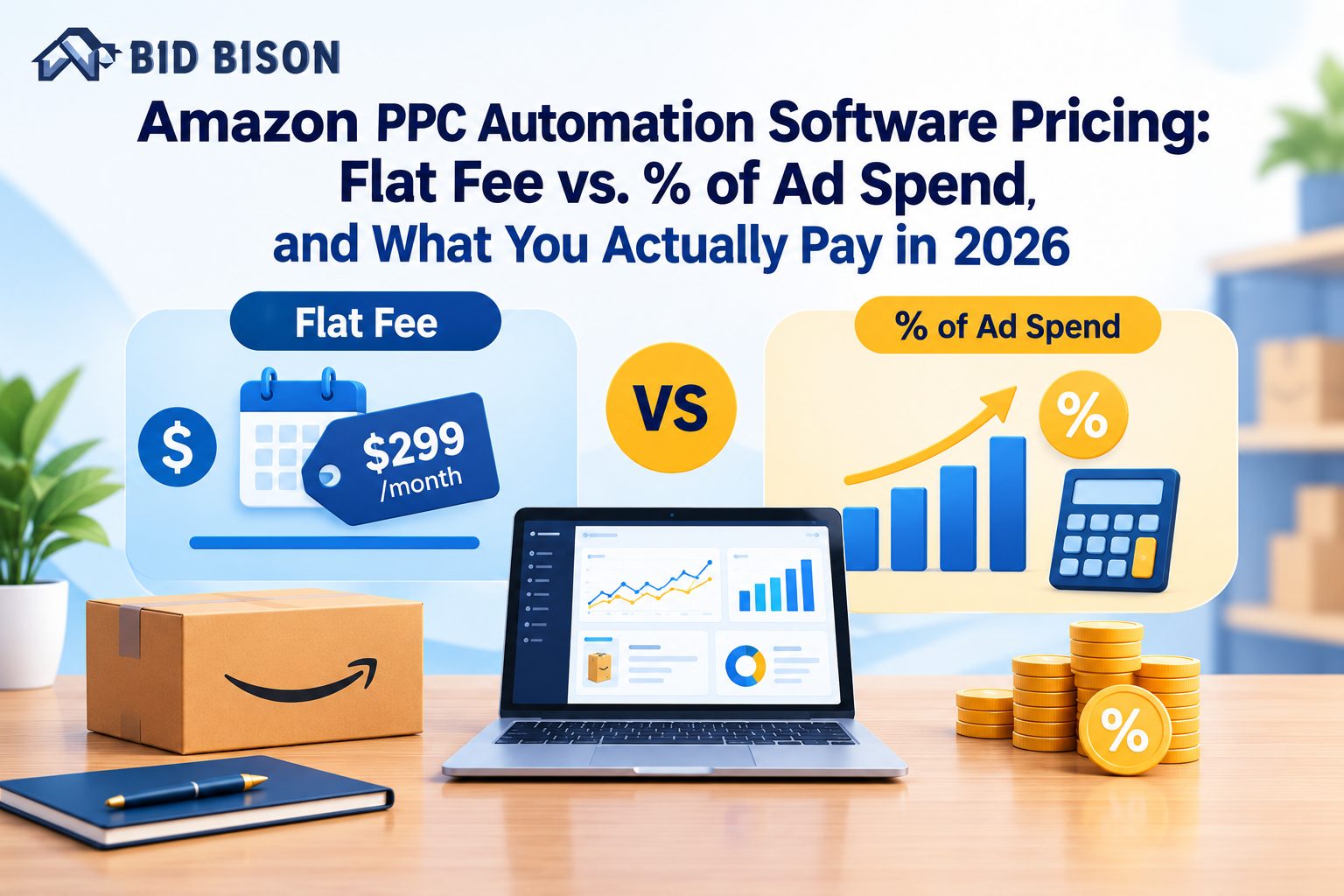
Quick answer: Amazon PPC automation software is usually priced in one of two ways. A flat monthly fee stays the same regardless of how much you spend on ads. A percentage of ad spend model typically charges a small cut of your monthly advertising budget. Flat fees are generally more cost-efficient as your ad spend grows, while percentage models can look cheaper at very low budgets. The right choice depends on your spend, your growth plans, and how much cost predictability you need.
If you are trying to decide how to buy Amazon PPC automation software without overpaying, this guide breaks down both pricing models, the hidden costs, and how to calculate your real cost before you commit.
What Is Amazon PPC Automation Software?
Amazon PPC automation software is a tool that manages your Amazon advertising campaigns using rules, algorithms, or artificial intelligence. It adjusts bids, adds negative keywords, harvests search terms, reallocates budgets, and monitors performance around the clock, so you do not have to do it by hand.
Modern Amazon PPC AI software goes a step further than basic rule-based tools. Instead of only following "if X, then Y" logic, AI Amazon PPC software learns from your data, such as conversion rates, search term trends, and profitability targets, and makes bidding decisions at a scale no person could match.
A typical Amazon PPC management tool handles:
- Automated bid optimization at the keyword, target, and placement level
- Search term harvesting and negative keyword management
- Budget pacing and campaign structure recommendations
- Reporting on ACoS, TACoS, ROAS, and profitability
- Alerts for anomalies such as budget caps, stock-outs, or sudden CPC spikes
Because the category is so broad, pricing varies a lot. That is why the pricing model matters as much as the feature list.
The Two Main Pricing Models for Amazon PPC Software
Model 1: Flat Monthly Fee
A flat fee means you pay a fixed amount each month, usually tiered by features, number of marketplaces, or number of products, not by how much you spend on Amazon ads.
How it works: You choose a plan, and the price stays the same whether you spend $5,000 or $50,000 on advertising that month.
Advantages:
- Predictable costs. You can forecast software spend precisely.
- Scales in your favor. As your ad budget grows, your software cost does not.
- No incentive conflict. The vendor does not earn more just because you spend more.
- Easy ROI math. You can compare a fixed cost against clear savings or sales lift.
Disadvantages:
- Can feel expensive for brand-new sellers with very small ad budgets
- Plans may be tiered, so heavy users might need to upgrade
- You pay even in slow months
Model 2: Percentage of Ad Spend
A percentage-of-ad-spend model charges a share of your monthly Amazon advertising budget, typically a low single-digit percentage, sometimes with a monthly minimum.
How it works: If you spend $20,000 on ads and your tool charges 3%, you pay $600 for the month.
Advantages:
- Low entry cost when your ad budget is small
- Cost flexes down in slow months or seasonal troughs
- Often bundled with managed-service support
Disadvantages:
- Cost rises as you scale. Success becomes more expensive.
- Misaligned incentives. A vendor paid on ad spend benefits when you spend more, not necessarily when you spend better.
- Less predictable. Seasonal peaks like Prime Day and Q4 can inflate your software bill.
- Minimums and tiers can erase the "pay only for what you use" appeal.
Flat Fee vs. % of Ad Spend: A Side-by-Side Comparison
| Factor | Flat Monthly Fee | % of Ad Spend |
|---|---|---|
| Cost predictability | High | Low to medium |
| Best for | Growing and mid-to-large advertisers | Very small budgets or short-term testing |
| Cost as spend grows | Stays the same | Increases proportionally |
| Incentive alignment | Neutral | Vendor benefits from higher spend |
| Q4 and Prime Day impact | None | Higher bill |
| Budgeting ease | Simple | Requires forecasting |
What Do You Actually Pay? Real-World Cost Scenarios
Let's compare the two models with an illustrative example. The numbers below are hypothetical and intended to show how the math behaves; they are not a quote from any vendor.
Assume a percentage model of 3% and a flat fee of $300 per month.
| Monthly Ad Spend | 3% of Ad Spend | Flat Fee ($300) | Difference |
|---|---|---|---|
| $5,000 | $150 | $300 | Percentage cheaper by $150 |
| $10,000 | $300 | $300 | Break-even |
| $25,000 | $750 | $300 | Flat fee saves $450 |
| $50,000 | $1,500 | $300 | Flat fee saves $1,200 |
| $100,000 | $3,000 | $300 | Flat fee saves $2,700 |
The pattern is clear: below the break-even point, a percentage model can be cheaper. Above it, the gap widens fast. Over a year, a seller spending $50,000 per month could pay $14,400 more under the percentage model in this example.
Calculate Your Own Break-Even Point
Use this simple formula:
Break-even ad spend = Flat monthly fee ÷ Percentage rate
Example: $300 ÷ 0.03 = $10,000. If you spend more than $10,000 per month, the flat fee wins.
The Hidden Costs of Amazon PPC Automation Software Pricing
The sticker price rarely tells the whole story. Before you buy Amazon PPC automation software, check for these.
Setup and Onboarding Fees
Some vendors charge a one-time fee to connect your account and configure campaigns.
Minimum Monthly Commitments
A percentage-based plan with a high minimum can make a "3% of spend" offer cost far more than 3% when your spend is lower than expected.
Per-Marketplace or Per-Seller-Account Charges
Selling in the US, UK, and Germany? Some tools bill each marketplace separately.
Feature Gating
Advanced capabilities such as AI bidding, dayparting, or custom reports may sit behind higher tiers.
Contract Length and Cancellation Terms
Annual lock-ins and auto-renewals can trap you in a tool that is not performing.
Opportunity Cost of Poor Optimization
The most expensive software is the one that wastes your ad budget. If a tool costs $200 per month but lets $2,000 of spend leak into non-converting clicks, it is costing you far more than the subscription.
What Should AI Amazon PPC Software Deliver for the Price?
Pricing only makes sense in relation to value. A good Amazon PPC management tool should help you:
- Reduce wasted ad spend by pausing or lowering bids on non-converting terms
- Improve ACoS and TACoS without sacrificing sales volume
- Save hours of manual work on bid changes, reports, and search term mining
- Scale campaigns safely with guardrails tied to your profit targets
- Provide transparency so you can see why bids changed, not just that they did
How to judge ROI: Estimate the hours you spend on PPC each month, multiplied by your hourly value, plus any ad spend you expect to recover through better efficiency. Compare that total with the subscription cost. If the software pays for itself within the first one to two months, the pricing is likely reasonable.
How to Choose Between Flat Fee and Percentage Pricing
Choose a Flat Fee If:
- Your monthly ad spend is above roughly $10,000 (check your own break-even)
- You plan to scale ad spend over the next 12 months
- You want clean, predictable budgeting
- You sell seasonally and do not want Q4 to inflate your software bill
Choose a Percentage Model If:
- Your ad spend is very low or highly irregular
- You are running a short-term test of automation
- You want bundled hands-on service and accept the cost trade-off
Questions to Ask Any Vendor Before You Buy
- Is pricing based on a flat fee, a percentage, or a hybrid?
- Are there minimums, setup fees, or per-marketplace charges?
- What happens to my bill during Prime Day and Q4?
- Which AI features are included in each plan?
- Is there a free trial, and can I cancel without penalty?
- Who owns the data and the campaign structure if I leave?
Flat Fee vs. Percentage: Which Model Aligns Better With Your Goals?
There is a quiet but important point most pricing pages skip: incentives.
When a vendor is paid a percentage of your ad spend, its revenue rises when your budget rises, whether or not your profitability improves. That does not make the vendor dishonest, but it does mean the pricing model and your goals may not point in the same direction.
With a flat fee, the vendor's incentive is to keep you subscribed by delivering results: lower ACoS, better efficiency, and time saved. For sellers who care about profitability over raw spend, that alignment matters.
A Practical Checklist for Buying Amazon PPC Automation Software in 2026
Before you commit, run through this list:
- Calculate your average monthly ad spend over the last six months
- Compute your break-even point for flat vs. percentage pricing
- Confirm what AI features are included at your tier
- Ask about hidden fees, minimums, and contract terms
- Test the tool on a limited set of campaigns first
- Define success metrics in advance, such as ACoS target, hours saved, or ad waste reduced
- Review results after 30 to 60 days before scaling up
Frequently asked questions
How much does Amazon PPC automation software cost?
Is flat-fee Amazon PPC software better than percentage-based pricing?
What is the difference between Amazon PPC automation and Amazon PPC AI software?
Can small sellers benefit from Amazon PPC software?
Does Amazon PPC automation software guarantee lower ACoS?
Final Thoughts: Pay for Results, Not for Your Own Growth
The best Amazon PPC automation software is the one that lowers wasted spend, saves your time, and costs a fair, predictable amount. Percentage-of-ad-spend pricing can look attractive at small budgets, but it quietly turns your growth into a bigger software bill. A flat fee keeps your costs fixed while your results compound.
Do the math, ask direct questions about hidden fees, and test before you scale. Your software should work harder as your business grows, not charge you more for it.
Ready to see how smart, AI-driven PPC automation fits your budget? Explore BidBison and find the right plan for your Amazon advertising.
Flat pricing that never grows with your ad spend.
BidBison self-serve plans run $49 to $179 per month, with every feature included. 14-day free trial, credit card required.