Amazon Keyword Automation Explained: How to Find, Harvest, and Negate Keywords Without Manual Work
Reviewing search term reports, harvesting converting keywords and adding negatives by hand does not scale. Here is how automation handles the repetitive parts while you keep the strategy.
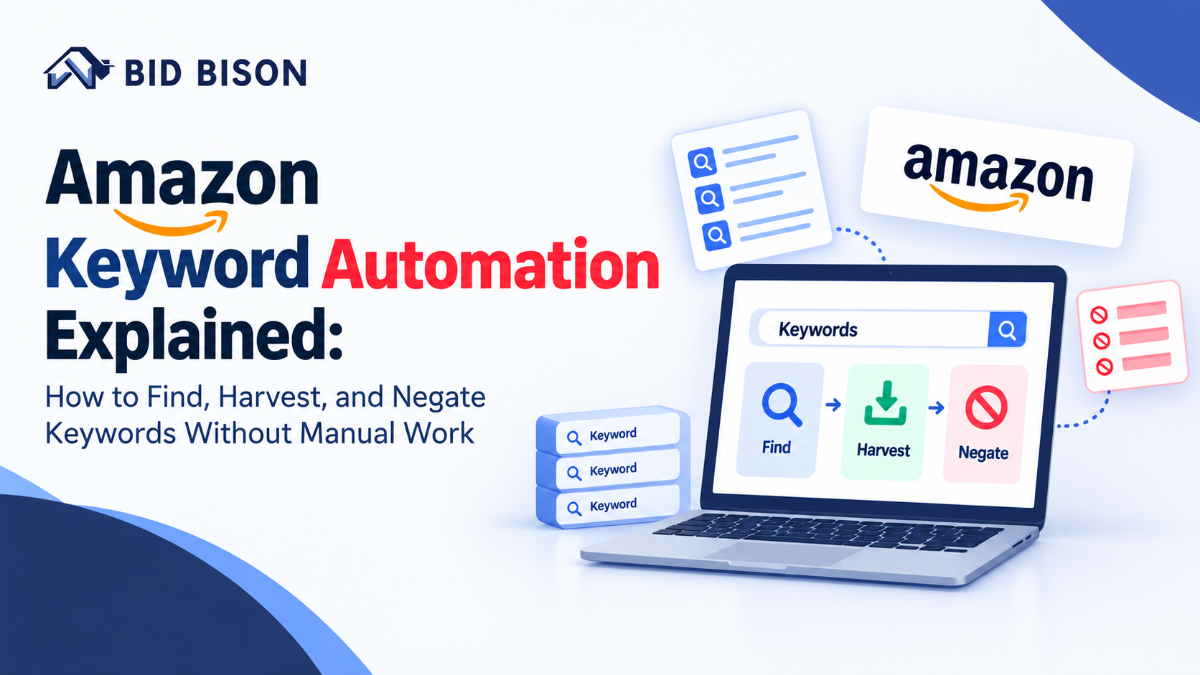
Managing Amazon PPC keywords manually can quickly become one of the most time-consuming parts of running an Amazon store. You have to review search term reports, find converting search terms, add new keywords, adjust bids, identify wasted spend, and add negative keywords. As campaigns grow, keeping up with all of this becomes harder and easier to get wrong.
That is where Amazon keyword automation can make a real difference. Instead of checking every campaign and search term by hand, automation can help identify useful keywords, move high-performing terms into the right campaigns, and reduce wasted spend through negative keyword rules. With the right Amazon PPC software, sellers can turn keyword management into a more consistent and scalable process.
What is Amazon keyword automation?
Amazon keyword automation is the process of using software, rules, and AI to manage keyword-related PPC tasks with less manual work. Instead of relying entirely on spreadsheets and repeated campaign checks, automation can analyze advertising data and take predefined actions based on performance.
For Amazon sellers, this can include finding new search terms, harvesting converting keywords, identifying irrelevant or expensive terms, adding negative keywords, and adjusting bids according to campaign goals.
The basic idea is simple: let software handle repetitive keyword tasks while you focus on strategy and business growth.
This does not mean removing human oversight. A good automation system should make routine decisions faster and more consistently while giving PPC managers control over the rules and thresholds being used.
Why manual keyword management no longer works
Manual keyword management can work for a small account with a limited number of campaigns. But as product catalogs, ad groups, keywords, and budgets grow, the workload grows with them.
Here are some of the biggest problems with relying entirely on manual processes.
Time-consuming research
Amazon PPC generates a large amount of search term data. Every click and conversion can provide useful information about what shoppers are actually searching for.
The problem is finding those opportunities manually. A PPC manager may need to download reports, sort search terms, compare metrics, identify converting terms, and then decide where those keywords should be added.
Doing this regularly takes time that could be spent on campaign strategy, product optimization, or other parts of the business. We put numbers on that trade-off in the real cost of manual Amazon PPC management.
Missed negative keywords mean wasted ad spend
Not every search term that receives clicks is valuable. Some terms may spend money without generating sales, while others may be irrelevant to the product altogether.
Negative keywords help prevent ads from showing for search terms that are unlikely to deliver profitable results. When negative keyword management is done manually, however, it is easy to miss terms that should be excluded.
Even a few missed opportunities across dozens of campaigns can make optimization more difficult.
Human error in bulk campaigns
Managing hundreds or thousands of keywords manually increases the chance of mistakes. A keyword can be added to the wrong campaign, a bid can be changed incorrectly, or a negative keyword can be missed.
These errors are not always obvious immediately. By the time they are discovered, the campaign may have already spent part of its budget inefficiently.
Automation helps create repeatable processes, reducing the need to perform the same tasks manually across every campaign.
How to find keywords automatically with Amazon PPC software
The first step in effective keyword automation is discovering opportunities from real advertising data. Modern Amazon PPC software can help sellers turn search behavior and campaign performance into actionable keyword insights.
Search term report automation
Search term reports show the actual queries shoppers used before clicking an ad. These reports are one of the most useful sources for finding new keyword opportunities.
Traditionally, sellers download the report, filter the data, and manually decide which terms should become keywords. An automated system can monitor this information continuously and identify search terms that meet specific performance conditions.
For example, you could create a rule that identifies search terms with conversions and acceptable advertising performance. Those terms can then be considered for keyword harvesting instead of waiting for a weekly or monthly manual review.
AI-based keyword discovery
AI can take keyword analysis a step further by looking for patterns across campaign data. Instead of simply sorting keywords by clicks or sales, AI-driven systems can help identify opportunities based on multiple performance signals.
An AI Amazon PPC software platform may analyze factors such as impressions, clicks, conversions, spend, sales, and advertising cost of sales (ACoS) to determine which search terms deserve attention.
The goal is not to replace PPC strategy. It is to reduce the amount of repetitive analysis required to find useful opportunities. We compare the two approaches directly in rule-based vs AI-driven Amazon PPC.
Competitor keyword insights
Keyword discovery does not have to come only from your existing campaigns. Competitive research can also reveal terms that are relevant to your product category.
For example, sellers can research competitor listings, category search behavior, and keyword opportunities to build a broader keyword strategy. These insights can then be tested through Amazon advertising campaigns.
Automation makes it easier to organize and evaluate keyword opportunities without maintaining multiple spreadsheets or manually tracking every change.
How to harvest keywords the smart way
Finding a keyword is only the beginning. The next question is what to do with it.
Keyword harvesting means taking a search term that has demonstrated value and moving it into a campaign or ad group where it can be managed more deliberately. This is particularly useful when working with different match types and campaign structures.
Auto-to-manual campaign harvesting
A common PPC strategy is to use automatic campaigns to discover search terms and then move strong-performing terms into manual campaigns.
For example, if a search term from an automatic Sponsored Products campaign generates sales at an acceptable ACoS, you may want to add that term as a keyword in a manual campaign.
Doing this manually across multiple campaigns can become repetitive. An automated workflow can monitor performance and identify search terms that meet your chosen criteria for harvesting.
This allows automatic campaigns to act as discovery tools while manual campaigns provide more control over valuable keywords.
Setting harvesting rules and thresholds
Automation works best when the rules match your actual PPC strategy.
Instead of harvesting every search term that gets a click, you can use performance thresholds. Depending on your goals, these may include sales, conversions, clicks, spend, or ACoS.
For example, a seller could establish a rule that considers a search term for harvesting after it generates a conversion while maintaining an acceptable ACoS. Another seller may prefer a more conservative approach based on multiple conversions.
The important point is that the thresholds should reflect your campaign goals, product margins, and level of risk. Automation should follow a strategy rather than operate without direction.
How to negate keywords automatically and save ad spend
Keyword harvesting helps you find opportunities, but effective PPC optimization also requires knowing what to stop targeting.
Negative keywords tell Amazon not to show an ad for specific search terms or phrases. They can be useful when a search query is irrelevant or consistently spends money without producing the desired results.
Identifying wasted spend keywords
One of the biggest advantages of automation is the ability to monitor search terms continuously.
Instead of manually reviewing every keyword for poor performance, an automated system can flag terms that meet specific wasted spend conditions. These might include a certain amount of spend without a sale, excessive clicks without conversion, or search terms that do not match the product.
The exact threshold will depend on the product and campaign. A high-priced product may need more clicks before you judge performance, while a lower-priced product may require a tighter threshold.
Auto-negation rules
Once a keyword or search term meets your negative keyword criteria, automation can help add it to the appropriate campaign or ad group.
This is where an Amazon PPC AI software solution can be particularly useful. Instead of waiting for a manual review, the system can monitor campaign performance and apply predefined negation rules consistently.
Automation can also help reduce the risk of making the same judgment repeatedly across multiple campaigns.
The key is to avoid overly aggressive rules. A keyword that has not converted after a few clicks is not necessarily a bad keyword. Negative keyword automation should consider enough performance data to make a reasonable decision.
Benefits of using an Amazon PPC management tool
An Amazon PPC management tool can bring keyword discovery, harvesting, negation, and other optimization tasks into a single workflow.
Here are some of the main benefits.
Saves time
The biggest advantage is often simple: less repetitive work.
Instead of spending hours reviewing search term reports and making the same campaign updates manually, PPC managers can automate routine actions and spend more time on strategy.
Helps control ACoS
ACoS, or advertising cost of sales, shows how much advertising spend is being used to generate sales. While ACoS should not be the only metric you track, controlling inefficient spend can help improve campaign performance.
Automated harvesting can help focus attention on keywords that are producing results, while automated negation can reduce spending on terms that consistently fail to meet your criteria. If you are weighing ACoS against total ad cost, ACoS vs TACoS covers the difference.
Makes scaling easier
Managing five campaigns manually is very different from managing dozens or hundreds.
As an Amazon business grows, automation becomes more valuable because the same processes can be applied across a larger campaign structure. This allows PPC managers to scale their workflows without increasing manual work at the same rate.
Improves consistency
People can make different decisions depending on workload, time, or how closely they review a report. Automation follows the rules consistently.
For teams managing multiple Amazon accounts or large product catalogs, that consistency can make campaign management easier to monitor and repeat.
Why use BidBison for Amazon PPC?
BidBison brings keyword automation and other PPC optimization tasks into one simple workflow. Instead of switching between spreadsheets, reports, and separate tools, sellers can use the platform to automate important parts of their Amazon advertising process.
The BidBison Amazon PPC software approach combines automation with performance-based rules to help sellers manage campaigns more efficiently.
Automated keyword harvesting
BidBison can help identify search terms that meet your selected performance conditions and support the process of moving valuable keywords into the right campaign structure.
This makes it easier to turn search term data into actionable keywords without repeatedly checking reports by hand.
Automated keyword negation
BidBison can also help identify keywords that are consuming budget without delivering the results you want. Automated negation rules can reduce the need to manually search through campaigns for wasted spend terms.
The goal is to make negative keyword management a repeatable part of your PPC workflow.
Bid optimization in one dashboard
Keyword management is only one part of Amazon PPC. Bids also need regular attention as competition, conversion rates, and campaign performance change.
BidBison combines keyword harvesting, keyword negation, and bid optimization around a target ACoS within one dashboard, giving sellers a centralized way to manage their advertising workflow.
If you are looking for Amazon PPC automation software that can reduce repetitive work while keeping your campaign strategy under your control, automation can be a practical next step.
How to get started with Amazon keyword automation
Moving from manual management to automation does not have to happen all at once.
Start by identifying the repetitive tasks that take the most time. For many sellers, these include reviewing search term reports, finding converting search terms, adding negative keywords, and adjusting bids.
Next, define clear rules for each task. Decide what performance conditions should trigger keyword harvesting, when a search term should be considered for negation, and how aggressively bids should be adjusted.
Finally, monitor the results. Automation should make your workflow easier, but performance still needs to be reviewed regularly. Use the data to refine your rules as your products, margins, competition, and advertising goals change.
A good automation strategy is not about putting every PPC decision on autopilot. It is about automating repetitive decisions while keeping important strategic decisions in human hands.
Final thoughts: why Amazon keyword automation matters
Amazon PPC becomes harder to manage as campaigns and product catalogs grow. Manually reviewing every search term, finding new keywords, adding negatives, and adjusting campaigns can consume valuable time and create opportunities for errors.
Amazon keyword automation provides a more scalable way to handle these repetitive tasks. By using search term data, performance rules, AI-driven analysis, automated harvesting, and negative keyword management, sellers can build a more consistent PPC workflow.
The right Amazon PPC software should not make your strategy more complicated. It should help you spend less time on repetitive campaign maintenance and more time making decisions that grow your business.
What is Amazon Keyword Automation?
How does Amazon Keyword Automation help reduce wasted ad spend?
Can Amazon PPC software automatically harvest converting keywords?
Is AI Amazon PPC software suitable for small Amazon sellers?
How does BidBison automate Amazon PPC keyword management?
Stop managing keywords by hand.
Harvesting, negation and bid optimization in one dashboard. 14-day free trial, credit card required.