How Do You Choose an Advertising Agency for Amazon?
A seven-step scorecard, the questions to ask, pricing models compared and the red flags that should end the conversation.
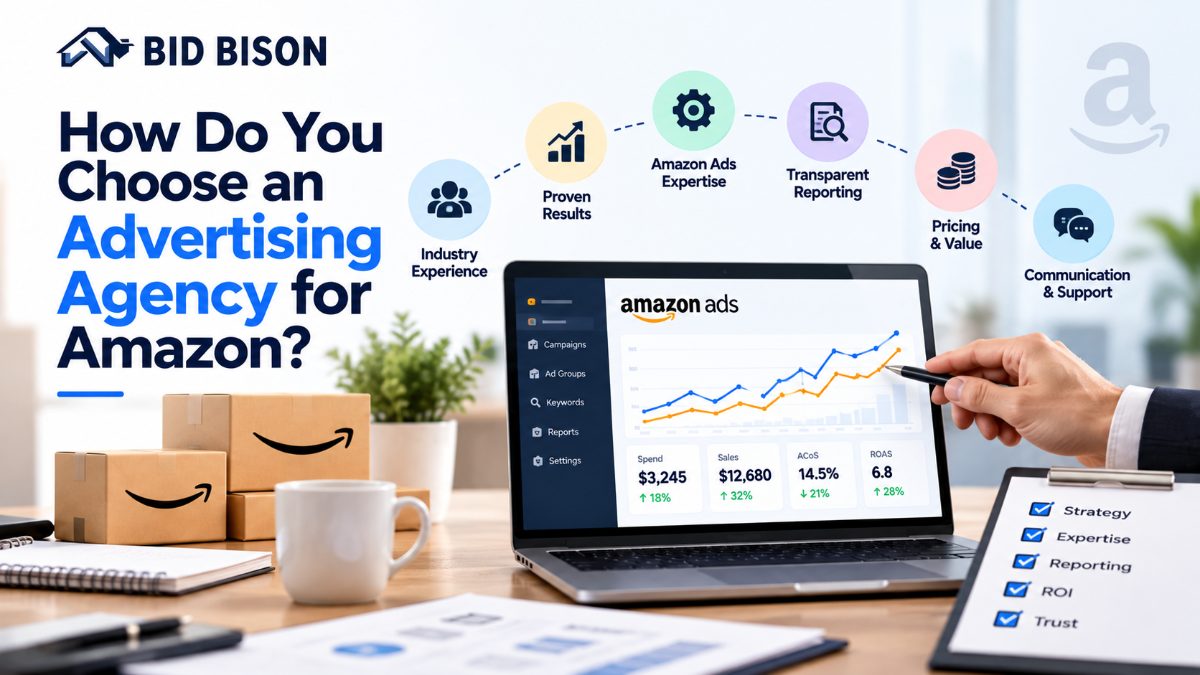
The best way to choose an advertising agency for Amazon is to verify its Amazon Ads experience, check how it reports results, confirm how it controls ACoS and budgets, and compare pricing models. Pick an agency that gives you account access, explains its bidding method, and ties its work to measurable outcomes.
What does an advertising agency for Amazon do?
An advertising agency for Amazon plans, launches and optimizes paid campaigns on Amazon Ads. Its work covers keyword research, bid management, budget allocation, negative keywords and reporting, all aimed at growing sales at a profitable ad cost.
Most agencies manage three ad types:
- Sponsored Products: keyword- or ASIN-targeted ads for single listings.
- Sponsored Brands: banner and video ads that promote a brand and its product range.
- Sponsored Display: retargeting and product-targeting ads on and off Amazon.
Not sure how to split budget across them? Read this Sponsored Products vs. Sponsored Brands vs. Sponsored Display budget guide.
Some agencies add listing optimization and Amazon DSP. Others focus on Amazon PPC (pay-per-click), where you pay only when a shopper clicks your ad.
When should you hire an Amazon agency instead of going in-house?
Hire an agency when ad spend grows faster than your team can manage, when ACoS stays above break-even, or when you lack a dedicated Amazon PPC specialist. Stay in-house if you have the skills, time and a small catalog.
Signs it is time to get outside help:
- Your ACoS has stayed above break-even for more than two months.
- You manage more than 50 active campaigns with no consistent structure.
- You launch new products but cannot get them ranking.
- Nobody on your team reviews search term reports every week.
Manual management also has a hidden price tag. See the real cost of manual Amazon PPC management before deciding.
How do you choose an advertising agency for Amazon?
Choose an agency by checking its Amazon Ads track record, testing its transparency, and comparing strategy and pricing across at least three candidates. Use the steps below as a scorecard.
Step 1: Define your goal and break-even ACoS
Write down your target. It could be profitable sales, rank growth for a launch, or brand defense. ACoS (Advertising Cost of Sale) is ad spend divided by ad-attributed sales. Your break-even ACoS equals your profit margin before ad costs.
Use the free ACoS calculator to find your number, and read what a good ACoS for Amazon PPC looks like.
Step 2: Check Amazon Ads experience in your category
Ask for work in your niche and price range. A strategy for supplements differs from one for $400 electronics. Look for case studies with named metrics, not vague claims.
Step 3: Confirm verified credentials
Check whether the agency is listed in the Amazon Ads partner network. Credentials do not guarantee quality, but they show a baseline of platform knowledge.
Step 4: Ask how they bid and structure campaigns
A strong agency explains campaign structure, match-type strategy, bid rules and how often it adjusts. If the answer is "proprietary secret," keep looking.
Step 5: Demand transparent reporting
You should see ACoS, TACoS (total ad spend divided by total sales), ROAS, impressions, click-through rate and conversion rate. Reports should arrive on a fixed schedule, ideally weekly. Learn the difference in ACoS vs. TACoS.
Step 6: Review the contract terms
Check the minimum term, the notice period, who owns the ad account, and whether you keep campaign data if you leave. Avoid long lock-ins with no exit clause.
Step 7: Run a 60-90 day test
Start with a defined scope and agreed KPIs. Review ACoS, sales and rank movement at 30, 60 and 90 days before you expand spend.
What questions should you ask an Amazon PPC agency?
Ask questions that expose method, ownership and accountability. The answers show whether the agency has a repeatable process or improvises.
- Who will manage my account day to day, and how many accounts do they handle?
- Do I keep full access to Seller Central and the Amazon Ads console?
- How do you set target ACoS for each product?
- What Amazon PPC automation software do you use?
- How often do you adjust bids and budgets?
- Which KPIs will you report, and how often?
- What happens to my campaigns if we part ways?
Want a head start? Run a free PPC waste audit on your account first. It gives you concrete numbers to bring to every agency call.
How much does an Amazon PPC managed service cost?
Amazon PPC agencies usually charge a flat monthly retainer, a percentage of ad spend, or a hybrid. Cost depends on spend level, catalog size and scope.
| Pricing model | How it works | Best for | Watch out for |
|---|---|---|---|
| Flat retainer | Fixed monthly fee | Stable, predictable budgets | Low incentive to push growth |
| % of ad spend | Fee scales with spend | Growing accounts | Agency earns more when you spend more, even if ACoS is poor |
| Performance-based | Fee tied to sales or ACoS goals | Brands with clear targets | Unclear baselines, metric gaming |
| Hybrid | Retainer plus bonus | Balanced accountability | Complex contracts |
Always ask what is included. Some paid search management service packages cover only Amazon ads, while others bundle Google and Meta.
Example of a flat-fee model: BidBison's Done for You managed service is $499 per month, billed flat, with a dedicated Amazon PPC specialist, live dashboard access and no long-term lock-in. The fee includes the software. Check the pricing page for current plans, since prices can change.
Agency, software or in-house: which is better?
Agencies bring strategy and experience, software brings speed and consistency, and in-house teams bring brand knowledge and control. Many brands get the best return by combining a specialist with automation.
| Option | Strengths | Limits |
|---|---|---|
| Agency | Expertise, strategy, outsourced workload | Higher fees, less control, varying quality |
| In-house team | Brand knowledge, full control | Hiring cost, training time |
| PPC software | 24/7 bid and budget changes, lower cost | Needs clear targets and some oversight |
| Specialist + software | Strategy plus fast execution | Requires setup and clear ownership |
Comparing tools? See the Amazon PPC software comparison for 2026 and the BidBison comparison hub.
How can AI optimize Amazon PPC campaigns?
AI optimizes Amazon PPC by analyzing performance data continuously and adjusting bids, budgets, keywords and ad schedules toward a target ACoS. It reacts faster than manual management and applies the same logic across thousands of keywords.
Here is what automation handles well:
- Bid management: raises bids on keywords converting below target ACoS and lowers bids on those that overspend.
- Budget allocation: shifts budget toward campaigns with the best return.
- Keyword harvesting: moves converting search terms from auto to manual campaigns. See search term harvesting.
- Negative keywords: blocks search terms that spend without converting. Read the negative keywords guide.
- Dayparting: adjusts bids by hour and day based on when your shoppers buy. Learn how dayparting and hourly bidding work.
- Reporting: consolidates performance into one dashboard, so reviews take minutes.
BidBison is Amazon PPC automation software built around this model. It automates bids, budgets, keywords, dayparting and reporting around the target ACoS you set. See how target ACoS automation works and how BidBison works.
Agencies and PPC professionals can use it to run more accounts consistently. Sellers can use it to cut manual workload.
Good AI still needs human direction. A person sets goals, margins and product priorities. The software executes within those limits. For a deeper look, read whether AI can manage Amazon ads better than a human and AI vs. rule-based Amazon PPC software.
Mini example: specialist plus automation
Illustrative scenario, not a real client result. A seller with 120 SKUs pays an agency to manage PPC manually. The agency reviews bids weekly. Between reviews, wasted clicks pile up on non-converting search terms.
The seller adds automation that adjusts bids daily and blocks irrelevant terms. The specialist now spends time on strategy: launches, new keyword themes and creative tests. The seller reviews weekly reports against the agreed ACoS target.
What are the red flags of a bad Amazon agency?
Red flags include guaranteed results, refusal to share account access, vague reporting and pressure to sign long contracts. An agency that cannot explain its bidding logic in plain language likely has no repeatable process.
Watch for these warning signs:
- Promises of a specific ACoS or sales number before reviewing your account.
- Agency-owned ad accounts that you cannot access.
- Reports with spend and sales but no ACoS, TACoS or search term detail.
- One-size-fits-all campaign structures for every client.
- No negative keyword process.
- Contracts of 12 months or more with no exit option.
Also compare how the agency handles launches. A solid new product launch framework should be part of any proposal.
Pro Tips and Common Mistakes to Avoid
Pro Tip: Before you interview agencies, export 60 days of your search term report and note your top wasted-spend terms. Ask each candidate how they would handle those terms. Their answers show more than any sales deck.
Common mistakes
- Choosing on price alone. A cheap retainer on a poorly run account costs more in wasted spend.
- Ignoring TACoS. ACoS shows ad efficiency, but TACoS shows whether ads grow total sales.
- Setting one ACoS target for every product. Launch products, bestsellers and low-margin items need different targets.
- Giving no feedback. Share inventory plans, promotions and margin changes. Agencies cannot optimize around facts they do not know.
- Judging results in two weeks. Amazon PPC needs data. Most accounts need several weeks before trends are reliable.
For more on cutting spend safely, read how to reduce ACoS without losing sales.
Conclusion
Choosing an advertising agency for Amazon comes down to proof, transparency and fit. Verify experience, demand clear reporting, understand the pricing model, and run a 60-90 day test before scaling spend.
Want a specialist and automation in one place? Explore BidBison's Done for You Amazon PPC service, start a 14-day free trial, or talk to the team.
Frequently asked questions
What does an Amazon advertising agency do?
How much does an Amazon PPC agency charge?
Is an Amazon PPC agency worth it?
What is a good ACoS for Amazon ads?
How long does an Amazon PPC agency take to show results?
A specialist and automation in one place.
Done for You is a flat $499/month with a dedicated Amazon PPC specialist. 14-day free trial, credit card required.